
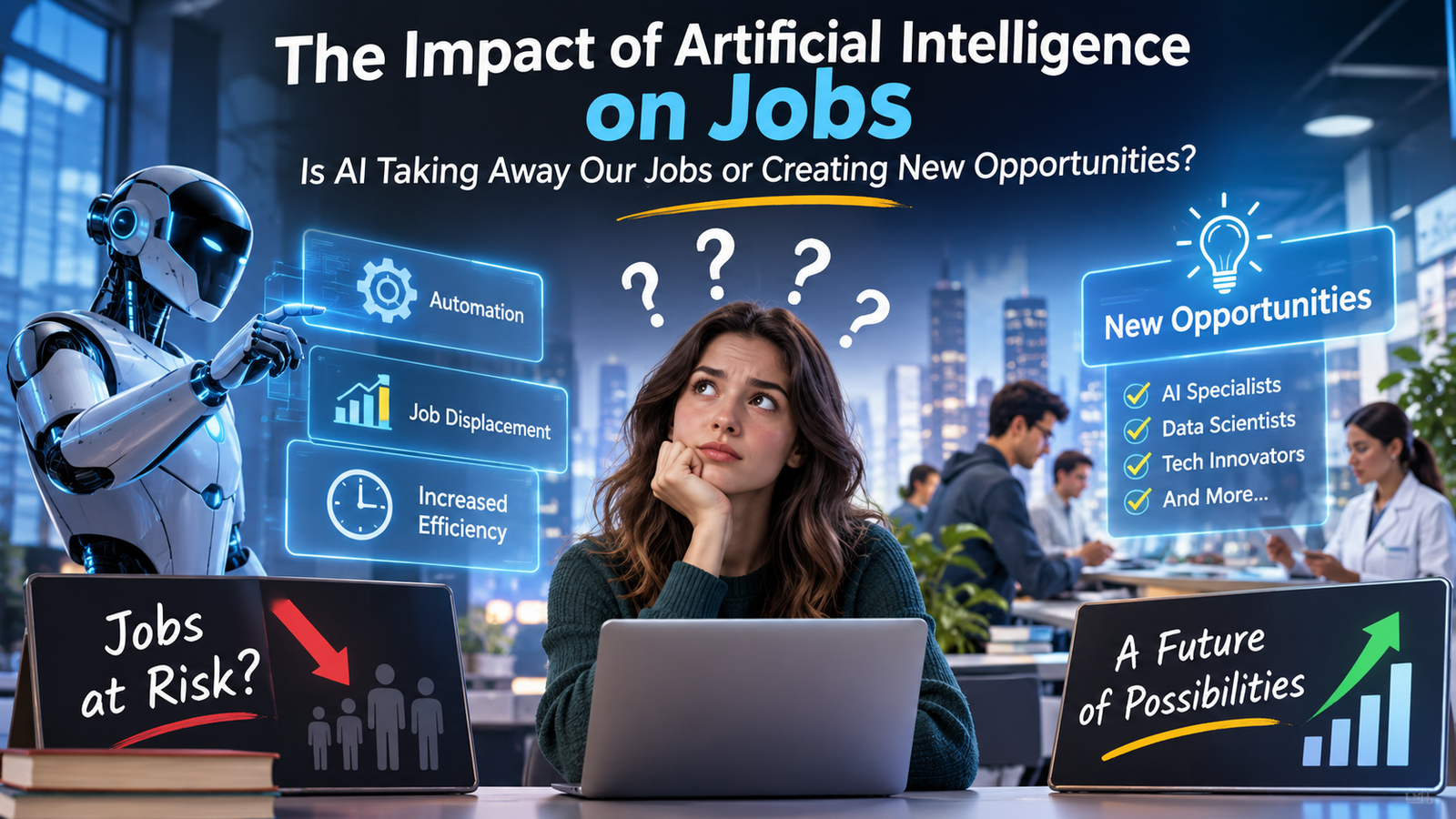
We are living in a time when technology is changing almost everything around us. From ordering food online to attending virtual classes, technology has become a part of our everyday lives. One of the biggest changes we are experiencing today is the growth of Artificial Intelligence (AI). What once seemed like something from a science fiction movie is now becoming a normal part of our daily routine.
AI can answer questions, write content, analyze information, create images, help doctors, and even perform tasks that previously required human effort. While these developments are exciting, they have also raised an important question in people’s minds: Will artificial intelligence take away our jobs?
This question is especially important for students, recent graduates, working professionals, and people preparing for their future careers. Some people see AI as a threat to employment, while others believe it will create new opportunities. The truth is that AI is bringing both changes and challenges to the world of work.
1. How AI Is Changing the Workplace
In the past, most office tasks were performed manually. Employees had to prepare reports, manage records, check documents, answer customer questions, and handle large amounts of information themselves.
Today, AI tools can complete many of these tasks in seconds. Businesses are using AI to save time, reduce repetitive work, and improve productivity.
For example, customer service companies use AI chatbots to answer common questions. Banks use AI to identify unusual transactions, while companies use AI software to analyze customer behavior.
This does not mean every employee will become unnecessary. Instead, the way people perform their jobs is changing. Employees are increasingly expected to understand technology and work alongside it.
2. Jobs That May Be Affected by AI
One of the biggest concerns about AI is its ability to automate repetitive tasks. Jobs that involve predictable and repeated activities may experience greater changes.
Some examples include:
- Data entry operators: AI can organize, process, and enter large amounts of information.
- Customer service representatives: Chatbots can handle basic customer questions at any time.
- Telemarketing workers: Automated systems can manage certain routine calls and messages.
- Content writers: AI can help generate simple descriptions, summaries, and routine written material.
- Accounting assistants: AI software can help with calculations, invoices, and record management.
- Manufacturing workers: Robots and automated machines can perform certain repetitive production tasks.
However, it is important to understand that a job is not always completely replaced just because some of its tasks can be automated. Human supervision, decision-making, communication, and responsibility are still important.
3. New Job Opportunities Created by AI
Although AI may reduce the need for certain types of work, it is also creating new career opportunities. Every major technological development brings new industries, and AI is no exception.
Some emerging career options include:
- AI specialists: People who develop and improve artificial intelligence systems.
- Data scientists: Professionals who study large amounts of data to help businesses make better decisions.
- Cybersecurity experts: People who protect computer systems and information from online threats.
- AI trainers: Individuals who help train AI systems to produce more accurate and useful results.
- Robotics engineers: Professionals who design and maintain intelligent machines.
- Machine learning engineers: People who develop systems that learn from data and improve their performance.
- AI ethics specialists: Professionals who help ensure that AI is used responsibly and fairly.
These careers show that AI is not only changing existing jobs but also opening doors to professions that were less common in the past.
4. The Impact of AI on Students and Recent Graduates
Students and recent college graduates are among the people who may feel the impact of AI the most. In the past, having a degree was often considered enough to begin a professional career. Today, companies are also looking for practical knowledge, communication skills, problem-solving abilities, and technical understanding.
For recent graduates, competition may become tougher because companies can use AI tools to complete some entry-level tasks. However, this should not discourage students.
Instead, students should focus on learning skills that make them valuable in the workplace. Understanding AI tools, improving communication skills, learning computer skills, and gaining practical experience can make a big difference.
The important thing is not to compete with AI in everything but to learn how to use it effectively.
5. Why Human Skills Will Always Matter
Even though AI is becoming smarter, there are certain things that still require human understanding.
For example, a machine can provide information about someone’s problem, but understanding their emotions and offering genuine comfort is different.
Some important human skills include:
- Creativity and original thinking.
- Emotional intelligence.
- Leadership and teamwork.
- Communication and relationship-building.
- Critical thinking and decision-making.
- Adaptability and problem-solving.
These skills are valuable because workplaces need people who can understand situations, take responsibility, and make thoughtful decisions.
AI can support human thinking, but it cannot replace every part of human experience.
6. The Impact of AI on Different Industries
AI is not limited to IT companies. It is becoming part of almost every industry.
Education: AI can help students understand difficult subjects, practice questions, and receive personalized learning support. Teachers can also use it to prepare learning materials.
Healthcare: AI can assist doctors in analyzing medical images, organizing patient information, and identifying possible health risks. However, medical decisions still require qualified professionals.
Banking: Banks use AI to detect suspicious transactions, improve customer service, and identify possible fraud.
Agriculture: Farmers can use AI-based systems to monitor crops, understand weather patterns, and identify certain plant diseases.
Transportation: AI is helping develop smart traffic systems, driver-assistance technology, and automated vehicles.
Marketing: Businesses use AI to understand customer preferences, study market trends, and create advertising strategies.
This shows that AI is becoming an important part of the modern economy.
7. Can AI Replace Human Creativity?
This is one of the most interesting questions about artificial intelligence.
Today, AI can create pictures, write stories, generate music, and produce videos. Because of this, people working in creative fields sometimes worry about their future.
However, creativity is not simply about producing something quickly. It also involves personal experiences, emotions, culture, imagination, and individual perspectives.
For example, an AI tool can help write a story, but the memories and real-life experiences behind a meaningful story come from people.
Writers, designers, photographers, artists, and content creators can use AI as a supporting tool rather than seeing it only as a competitor.
8. The Challenges of Artificial Intelligence in Employment
Along with its advantages, AI also brings some serious challenges.
Unemployment concerns: Workers whose responsibilities are heavily automated may need to find new roles or learn different skills.
Skill gaps: People who do not have access to digital education may find it difficult to compete in a technology-driven workplace.
Income inequality: The benefits of AI may not be shared equally among workers and businesses.
Privacy issues: AI systems often process large amounts of personal and professional information, creating concerns about data protection.
Overdependence on technology: Depending too much on AI can reduce independent thinking and problem-solving if people stop checking the information it provides.
These challenges show why businesses, educational institutions, and governments must work together to make technological development beneficial for everyone.
9. How Can We Prepare for an AI-Driven Future?
Instead of being afraid of AI, we should prepare ourselves for the changes it may bring.
Here are some practical steps:
- Learn basic AI tools and understand how they work.
- Improve communication and presentation skills.
- Develop computer and digital skills.
- Focus on creativity and critical thinking.
- Take online courses to learn new technologies.
- Gain practical experience through internships and projects.
- Stay updated on changes in your chosen industry.
- Learn to verify AI-generated information rather than trusting everything blindly.
Learning should not stop after completing school or college. In the coming years, people who are willing to update their skills may find it easier to adapt to changing job requirements.
10. The Role of Companies and Governments
Preparing for the future should not be the responsibility of employees alone. Companies and governments also have an important role to play.
Companies should provide training opportunities to employees whose jobs are changing because of automation. Rather than immediately replacing workers, businesses can consider helping them move into different roles.
Governments can support affordable digital education, vocational training, employment programs, and policies that protect workers.
Educational institutions should also update their teaching methods so students gain practical skills instead of focusing only on theoretical knowledge.
A successful transition to an AI-powered economy will require cooperation from everyone.
Conclusion: The Future Belongs to Those Who Adapt
Artificial intelligence is changing the meaning of work. Some jobs may disappear, others will change, and many new opportunities will emerge. There is no doubt that AI will play a major role in shaping the future of employment.
However, I believe we should not look at AI only as a job killer. We should also see it as a technology that can help people work smarter, save time, and explore new possibilities.
At the same time, we should never forget the importance of human intelligence, creativity, emotions, and responsibility.
For students and young professionals, the message is simple: Do not ignore AI, but do not depend on it completely either. Learn about it, understand its limitations, and develop skills that technology cannot easily replace.
In the future, the biggest competition may not be between humans and AI, but between people who know how to use AI and those who do not.
About the Author
