
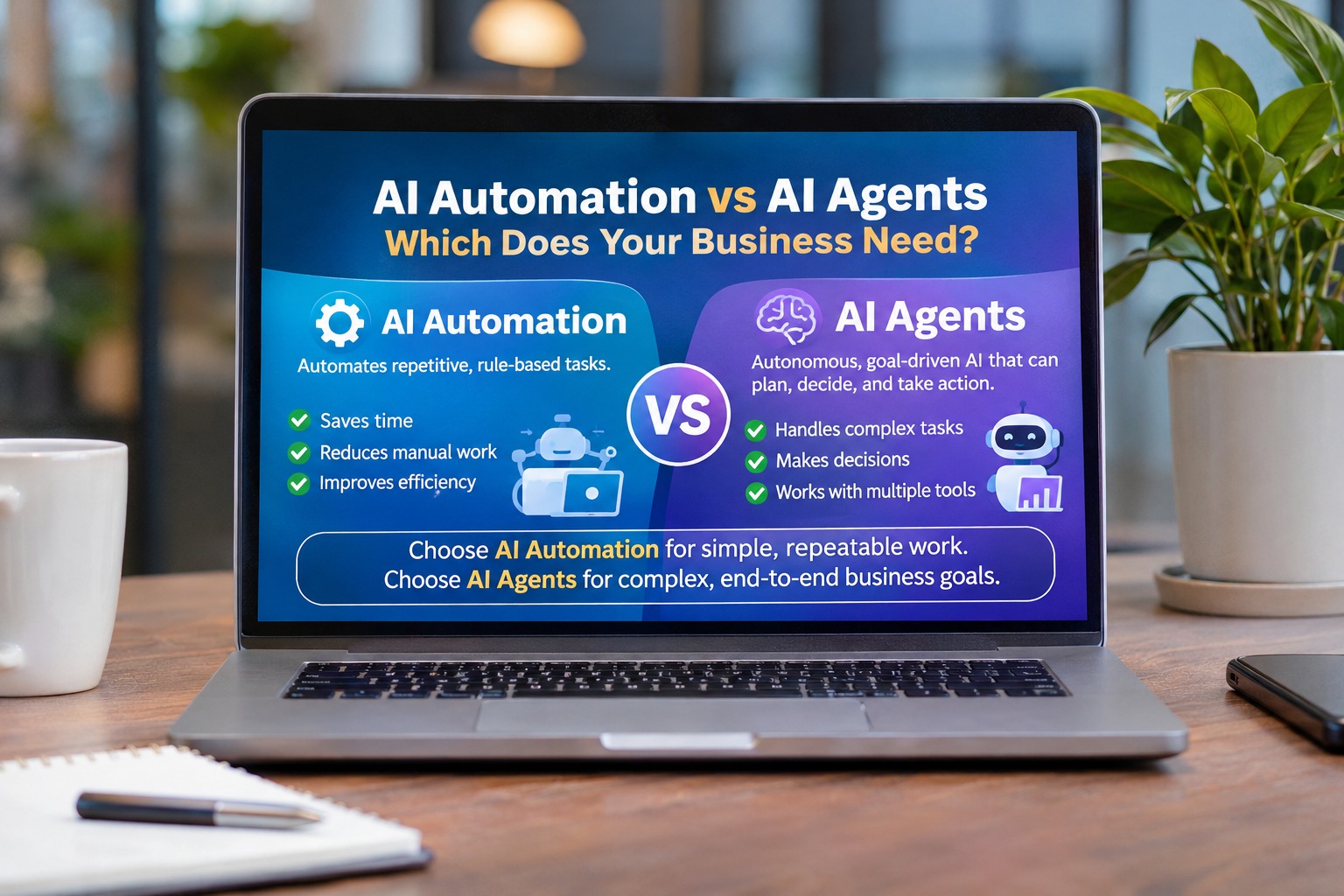
Artificial intelligence is changing the way businesses operate. Tasks that once required hours of manual effort can now be completed in minutes, customer queries can be handled around the clock, and business processes are becoming smarter and more efficient.
But as AI technology continues to develop, two terms are appearing more frequently in business conversations: AI Automation and AI Agents.
Although they may sound similar, they serve different purposes.
AI automation focuses on making repetitive tasks faster and more efficient, while AI agents can understand objectives, make decisions, and take action across multiple steps to achieve a goal.
So, which one should your business invest in?
The answer depends on your business requirements, the complexity of your processes, and the level of decision-making you want AI to handle.
Let’s understand the differences and explore how each technology can help your business grow.
What Is AI Automation?
AI automation is the use of artificial intelligence and automated workflows to perform tasks with minimal human involvement.
It helps businesses reduce repetitive work, minimise manual errors, and improve operational efficiency.
Think about the daily activities inside a business. Employees regularly send emails, update spreadsheets, process customer information, generate reports, and manage follow-ups.
Many of these activities follow predictable patterns. AI automation can handle such processes automatically once the workflow and conditions have been configured.
How Does AI Automation Work?
AI automation generally follows a predefined workflow.
For example:
- A customer submits an enquiry through your website.
- The system automatically collects the submitted information.
- The customer’s details are saved in your CRM.
- An automated confirmation email is sent.
- The sales team receives a notification.
The entire process happens without requiring an employee to perform each individual step.
AI can also add capabilities such as understanding customer messages, extracting information from documents, and classifying incoming requests.
Real-World Examples of AI Automation
Here are some common ways businesses use AI automation:
1. Automated Customer Support
Businesses can use AI-powered systems to answer frequently asked questions, share product information, and direct customers to relevant resources.
2. Email Automation
AI can categorise incoming emails, identify important messages, prepare responses, and trigger follow-up workflows.
3. Invoice Processing
Automation systems can extract information from invoices, organise financial records, and send documents for approval.
4. Lead Management
When someone fills out a contact form, the system can automatically save their information, assign the lead to a salesperson, and schedule a follow-up.
5. Report Generation
Businesses can automate regular reports by collecting information from different sources and presenting it in a structured format.
The biggest advantage is consistency. Once a workflow is properly configured, the system can repeat the same process whenever the required conditions are met.
What Are AI Agents?
AI agents take artificial intelligence a step further.
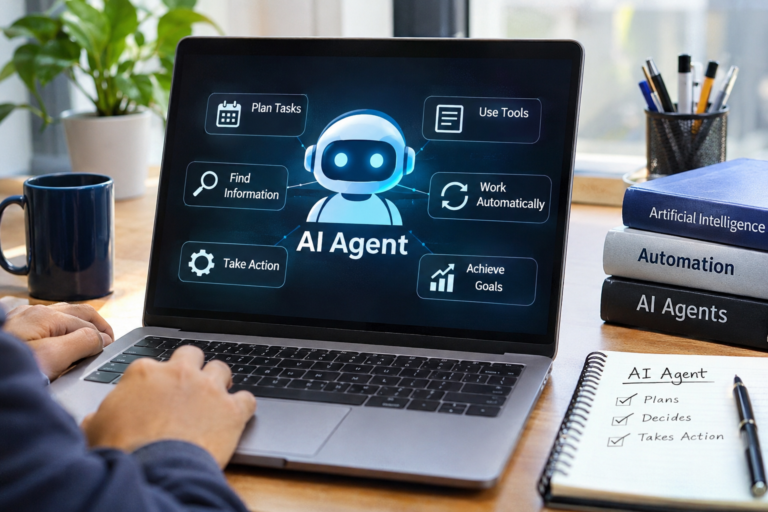
An AI agent is a system designed to understand a goal, gather relevant information, make decisions, and perform actions to complete a task.
Unlike traditional automation, which usually follows a predefined sequence, an AI agent can adapt its approach based on the information it receives.
In simple words, instead of telling AI exactly what to do at every step, you can give it an objective and allow it to determine the steps required to achieve it.
How Do AI Agents Work?
Imagine asking an AI agent:
“Find potential customers for our software product, research their businesses, prepare personalised introductory emails, and organise the results in our CRM.”
An AI agent may perform the following activities:
- Understand the business objective.
- Search for relevant companies using authorised data sources.
- Review available company information.
- Identify potential customers based on your requirements.
- Prepare personalised email drafts.
- Organise customer information in the CRM.
- Report completed activities and request approval where necessary.
The important difference is that the agent can decide what actions are needed along the way rather than simply executing one fixed sequence.
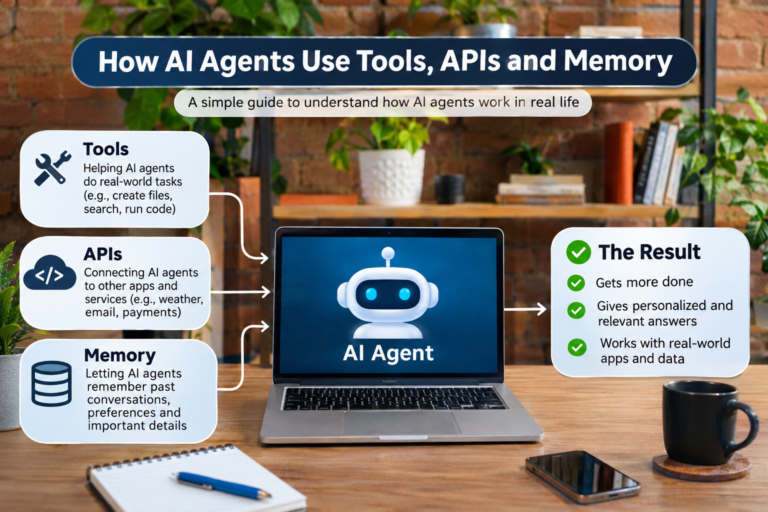
However, its capabilities depend on the tools, permissions, instructions, and information available to it.
Real-World Examples of AI Agents
1. AI Sales Agents
An AI sales agent can research potential customers, organise prospect information, prepare personalised messages, and assist sales teams with follow-ups.
2. AI Customer Service Agents
These agents can understand customer requests, retrieve relevant information, check order details through connected systems, and help resolve problems.
3. AI Research Agents
Businesses can use research agents to collect information, compare competitors, analyse market developments, and prepare summaries.
4. AI Recruitment Agents
AI agents can assist with organising applications, comparing candidate experience against job requirements, and scheduling interviews with appropriate human oversight.
5. AI Operations Agents
These agents can monitor business workflows, identify problems, gather relevant information, and recommend or perform approved corrective actions.
AI Automation vs AI Agents: Key Differences
Both technologies help businesses reduce manual work, but their working approaches are different.
| Comparison | AI Automation | AI Agents |
|---|---|---|
| Working approach | Predefined workflows | Goal-oriented actions |
| Decision-making | Mostly rule-based | Context-dependent decisions |
| Flexibility | Works within configured rules | Can adapt to changing situations |
| Task complexity | Simple to moderately complex | Moderately to highly complex |
| Human involvement | Setup and exception handling | Guidance and oversight |
| Best suited for | Repetitive tasks | Multi-step activities |
| Predictability | Generally higher | Depends on agent behaviour |
A Simple Example to Understand the Difference
Suppose you operate an online store.
A customer wants to know where their order is.
With AI Automation:
- The customer enters an order number.
- The system checks the order database.
- It retrieves the delivery status.
- An automated message is sent to the customer.
With an AI Agent:
- The customer explains that their order has not arrived.
- The agent understands the problem.
- It checks the order status and available delivery information.
- It identifies whether the order is delayed.
- It checks the permitted options for resolving the issue.
- It may prepare a replacement or refund request for approval.
The difference is not simply that one uses AI and the other does not. It is the level of flexibility and decision-making involved in completing the task.
Benefits of AI Automation for Businesses
AI automation is often the most practical starting point for businesses that want to improve efficiency without significantly changing their existing operations.
Some important benefits include:
1. Saves Time
Employees spend less time performing repetitive activities and can focus on more valuable work.
2. Reduces Operational Costs
Automating suitable tasks can reduce the amount of manual effort required to manage daily business operations.
3. Improves Accuracy
Well-designed workflows help reduce common human errors in data entry, information transfer, and routine processing.
4. Improves Productivity
Teams can complete routine processes faster and manage larger workloads without increasing manual effort at the same rate.
5. Provides Consistency
Automated workflows follow established instructions, helping businesses maintain consistent processes.
Benefits of AI Agents for Businesses
AI agents are particularly useful when business activities involve multiple steps, changing information, and decisions that cannot easily be covered by fixed rules.
1. Handles Complex Tasks
Agents can break larger objectives into smaller activities and work through them systematically.
2. Supports Better Decision-Making
They can analyse available information, compare options, and recommend suitable next steps.
3. Works Across Multiple Tools
With appropriate integrations and permissions, an agent can interact with CRM platforms, business applications, databases, and other tools.
4. Adapts to Changing Situations
When new information becomes available, an agent can adjust its approach instead of always following the same sequence.
5. Reduces Coordination Work
Agents can help manage tasks that require information from multiple departments or systems.
Which One Does Your Business Need?
There is no single answer for every organisation. The right choice depends on the problems you are trying to solve.
Choose AI Automation If:
- Your business performs the same tasks regularly.
- Your workflows follow predictable steps.
- You want to automate emails, reports, data entry, or notifications.
- Your team spends too much time on repetitive activities.
- You want a straightforward way to improve productivity.
Choose AI Agents If:
- Your business handles complex customer requests.
- Tasks require research and decision-making.
- You need AI to work across multiple applications.
- Your processes change depending on the situation.
- You want AI to manage broader objectives with human supervision.
Can Your Business Use Both?
Absolutely.
In fact, combining AI automation and AI agents can be more useful than choosing only one.
Consider a sales department.
An AI agent can research potential customers and prepare personalised outreach suggestions. Once a salesperson approves the suggestions, an automated workflow can send the emails, update the CRM, and schedule reminders.
In this example, the AI agent handles the more flexible research and preparation work, while automation manages the predictable follow-up activities.
This combination allows businesses to benefit from both flexibility and consistency.
Things to Consider Before Implementing AI
Before introducing either technology, businesses should evaluate a few important factors.
1. Identify the Actual Problem
Do not introduce AI simply because it is becoming popular. Identify the processes that consume time, create errors, or slow down business operations.
2. Evaluate Your Existing Systems
Check whether your current software, CRM, databases, and applications support the integrations you need.
3. Consider Data Security
AI systems may process sensitive business and customer information. Access permissions, data protection, and privacy policies should be carefully reviewed.
4. Start With a Small Project
Choose one business process, implement the solution, measure its performance, and improve it before expanding.
5. Maintain Human Oversight
Important decisions involving money, legal matters, customer commitments, and sensitive information should have appropriate approval and review mechanisms.
6. Measure Business Results
Track improvements in processing time, operating costs, error rates, customer satisfaction, and employee productivity.
The purpose of implementing AI is not to make business operations more complicated. It is to make them work better.
The Future of AI in Business
AI automation and AI agents are both becoming important parts of modern business operations.
Automation is making everyday workflows faster and more reliable, while AI agents are creating opportunities to manage more complicated tasks with less manual coordination.
As these technologies develop, businesses will increasingly combine traditional software, automated workflows, and intelligent agents to create connected operating systems.
However, technology alone does not guarantee better results. Successful implementation will depend on choosing the right processes, maintaining good-quality data, establishing clear permissions, and keeping people involved where their judgement matters.
Businesses that approach AI strategically will be better positioned to improve efficiency and respond to changing customer expectations.
Final Thoughts
AI automation and AI agents are not competing technologies. They solve different types of business problems and can work together.
If your primary requirement is to automate repetitive tasks, AI automation is a sensible starting point.
If you want a system that can understand goals, analyse information, make context-dependent decisions, and complete multiple connected activities, AI agents may be a better fit.
For many businesses, the best long-term approach is to begin with automation, identify opportunities for more advanced AI capabilities, and gradually introduce AI agents where they provide measurable value.
The real question is not whether your business needs AI automation or AI agents. It is where each technology can make your business more efficient, productive, and competitive.
Frequently Asked Questions (FAQs)
1. What is the main difference between AI automation and AI agents?
AI automation generally performs tasks through predefined workflows, whereas AI agents can understand goals, make context-dependent decisions, and determine the actions needed to complete a task.
2. Is AI automation better than AI agents?
Neither is universally better. AI automation is suitable for repetitive and predictable activities, while AI agents are useful for more complex tasks involving multiple steps and decisions.
3. Can small businesses use AI agents?
Yes. Small businesses can use AI agents for research, customer support, lead management, and other suitable activities. The choice should depend on the business need, cost, and available technical resources.
4. Are AI agents fully autonomous?
Not necessarily. Their autonomy depends on their design, permissions, available tools, and safeguards. Human approval is important for sensitive or high-impact actions.
5. Can AI automation and AI agents work together?
Yes. AI agents can handle flexible tasks such as research and decision-making, while automation can manage predictable activities such as notifications, data updates, and scheduled follow-ups.
6. How should a business start implementing AI?
Start by identifying a repetitive or time-consuming business process. Implement a small automation project, measure the results, and gradually explore AI agents for tasks that require more flexibility.
7. Do AI agents replace employees?
AI agents can reduce manual work and assist employees with complex tasks, but they still require human direction, supervision, and judgement. Their most practical role is often to support employees rather than replace the entire team.
About the Author