
Artificial intelligence has changed significantly over the past few years. Earlier, most people used AI mainly to ask questions, generate text, translate languages, or get quick answers. Today, AI systems are becoming much more capable. They can search for information, interact with applications, process data, perform tasks, and remember important details from previous interactions.
One of the biggest reasons behind this development is the combination of tools, APIs, and memory.
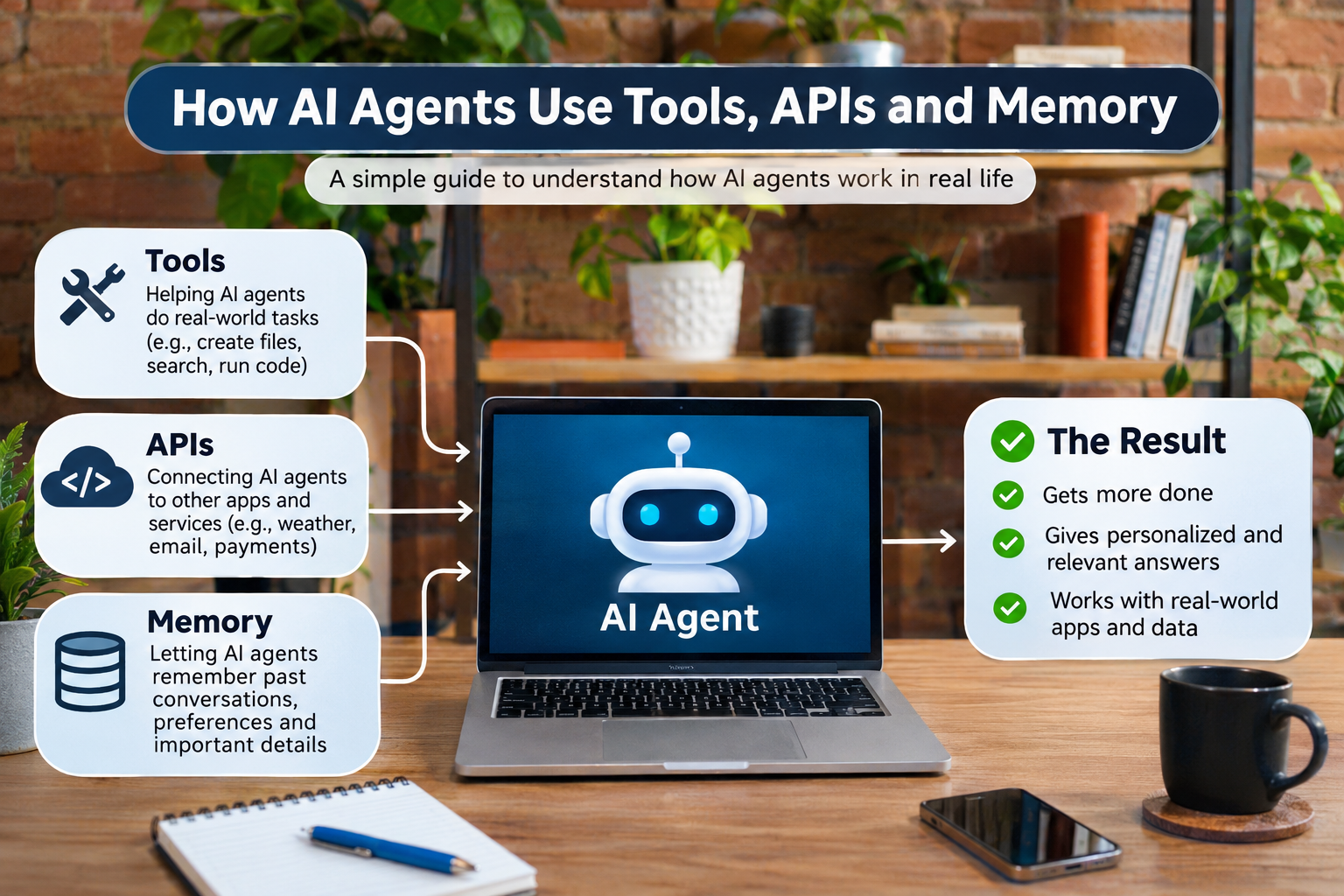
These three capabilities allow AI agents to move beyond simply responding to instructions. They help AI agents understand what needs to be done, decide which resources to use, perform actions, and keep track of relevant information.
But how does this actually work?
Let’s explore how AI agents use tools, APIs, and memory, why these technologies matter, and how they are changing the way people work with artificial intelligence.
Services & Solutions | Apes AI
What Is an AI Agent?
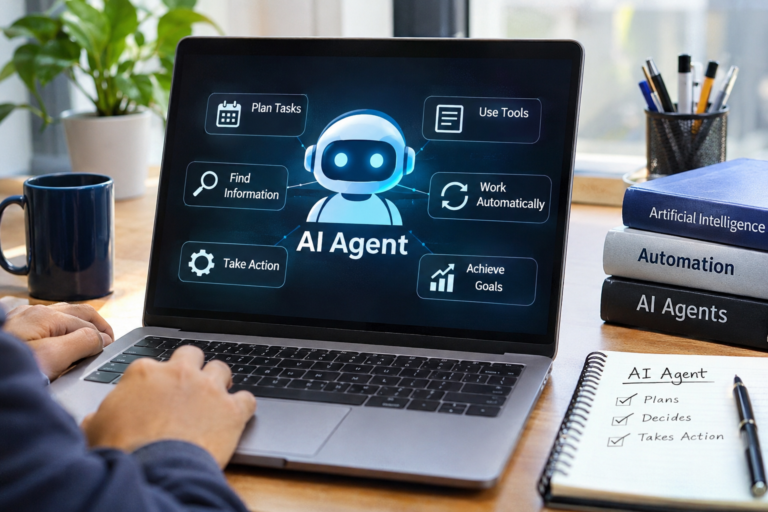
An AI agent is a software system that can understand a goal, plan the steps required to achieve it, and take actions using available tools and resources.
Unlike a traditional chatbot that mainly responds to user messages, an AI agent can work through multiple steps to complete a task.
For example, imagine asking an AI agent:
“Find five good hotels in Delhi, compare their prices, and prepare a summary.”
A basic chatbot might explain how to find hotels.
An AI agent with the right capabilities could:
- Understand what you are looking for.
- Search hotel websites or connected travel services.
- Collect hotel details and prices.
- Compare the available options.
- Organize the information.
- Prepare a final summary.
The important difference is that the agent can interact with external systems instead of relying entirely on the information it already knows.
Three capabilities make this possible:
- Tools: Allow the agent to perform tasks.
- APIs: Allow the agent to communicate with other software.
- Memory: Helps the agent retain and retrieve useful information.
1. How AI Agents Use Tools
Tools are one of the most important parts of an AI agent.
Think of tools as the agent’s hands. The AI model may be capable of understanding a request and planning a solution, but tools allow it to interact with the outside world.
Without tools, an AI agent may only be able to generate instructions or suggestions. With tools, it can perform specific operations.
Examples of Tools Used by AI Agents
GLM-5.1: 754B MoE model, AIME 95.3%, SWE-Bench Pro 58.4%, MIT licensed
Gemini×スプレッドシート|データ分析の精度をアンケート分類とグラフで検証 | Yoom
10
Here are some common examples:
1. Web Search Tools
An AI agent can use search tools to find current information, research topics, compare products, and discover relevant websites.
For example, if someone asks for the latest developments in artificial intelligence, the agent can search the web instead of relying only on previously learned information.
2. Coding Tools
Some agents can execute code, test programs, identify errors, and help developers automate technical tasks.
A developer might ask an agent to analyse a dataset or check why a particular function is not working.
3. File Management Tools
AI agents can work with supported file systems to create documents, organize information, read files, and prepare reports.
4. Email Tools
With appropriate access, an AI agent can search email conversations, prepare replies, organize messages, and perform other permitted email operations.
5. Data Analysis Tools
An agent can use calculation tools and analytical software to process information, identify patterns, and generate useful reports.
How Does an AI Agent Decide Which Tool to Use?
The agent generally follows a process:
- Understand the user’s request.
- Identify the operation required.
- Select an appropriate available tool.
- Send the required information to that tool.
- Receive and interpret the result.
- Decide whether another action is necessary.
For example, if you ask an agent to calculate monthly sales, it might use a spreadsheet or data analysis tool rather than a web search tool.
This ability to select and use tools makes AI agents more practical for real-world work.
2. How AI Agents Use APIs
Tools help AI agents perform operations, while APIs provide a structured way for different software systems to communicate.
API stands for Application Programming Interface.
In simple language, an API acts like a communication bridge between two software applications.
For example, imagine a travel booking application. It may need information about available flights, hotel prices, customer details, and payment status.
Instead of building every service from scratch, the application can communicate with external services through APIs.
AI agents use the same concept to interact with different platforms.
How APIs Work in AI Agents
Let’s understand this with a simple example.
Suppose you ask an AI agent:
“Check tomorrow’s weather in Delhi and prepare a suitable travel recommendation.”
The agent might follow these steps:
Step 1: Understand the request
The AI identifies that it needs weather information for a specific location and date.
Step 2: Select a weather API
It chooses an available weather service that provides forecast information.
Step 3: Send an API request
The agent sends information such as the location and requested date to the weather service.
Step 4: Receive the response
The API returns information such as temperature, rainfall probability, and weather conditions.
Step 5: Generate a recommendation
The AI interprets the returned information and prepares a useful response.
The user receives a recommendation without manually visiting a weather website.
Common APIs AI Agents Can Use
| API Type | What It Does |
|---|---|
| Weather API | Provides weather information |
| Payment API | Processes permitted payment operations |
| Email API | Connects with email services |
| Maps API | Provides maps and location information |
| CRM API | Accesses customer relationship data |
| Calendar API | Manages events and schedules |
| Database API | Retrieves or updates stored information |
Tools vs APIs: What Is the Difference?
These terms are closely related, but they are not exactly the same.
An API is an interface that allows software systems to communicate. A tool is an available capability that an AI agent can invoke.
For example:
- A weather API provides access to weather information.
- A weather tool gives an AI agent a defined way to request and use that information.
An agent may use an API directly or access it through a tool provided by a framework or application.
Understanding this distinction is important when developing AI-powered applications.
3. How AI Agents Use Memory
Memory is another important capability that makes AI agents more useful.
Imagine talking to an AI assistant every day. You repeatedly explain your work, preferences, project details, and requirements.
Wouldn’t it be easier if the assistant could retain relevant information and use it in future interactions?
That is the basic idea behind AI agent memory.
Memory allows an agent to store, retrieve, and use information that may be helpful when completing future tasks.
AI Agents That Remember: Building Long-Term Memory Systems | by Micheal Lanham | Medium
Why Do AI Agents Need Memory?
Without memory, an AI agent may need the same instructions repeatedly.
For example, suppose you manage a digital marketing business.
You tell your AI agent:
“Our target audience is small businesses. We prefer simple language, professional content, and informative blog articles.”
Later, you ask it to prepare a new blog.
If the agent has access to this information through an appropriate memory system, it can use your previously established preferences without asking you to explain everything again.
This makes interactions more consistent and efficient.
Different Types of AI Agent Memory
AI memory is commonly discussed in terms of short-term, long-term, and task-related memory.
1. Short-Term Memory
Short-term memory helps an agent maintain information during an ongoing interaction or task.
For example, if you ask an agent to compare three laptops, it needs to remember the specifications of each laptop while preparing the comparison.
This information may only be needed for that particular task.
2. Long-Term Memory
Long-term memory stores useful information that may be relevant across multiple interactions.
Examples include:
- User preferences.
- Project requirements.
- Frequently used instructions.
- Important business information.
- Previously established working patterns.
Long-term memory can help an agent provide more consistent assistance.
3. Episodic Memory
Episodic memory refers to information about previous experiences or events.
For example, an agent might retain a record of a previous project, the actions taken, and the final outcome.
This information can help it understand what happened before and make better decisions in a similar situation.
4. Semantic Memory
Semantic memory stores general facts, concepts, and knowledge.
For example, an AI agent working on a software project might retrieve information about the project’s database structure, technical documentation, or business terminology.
How Is AI Agent Memory Stored?
Depending on the system, memory can be maintained in several ways:
- Databases.
- Vector databases.
- Structured storage systems.
- Conversation history.
- Knowledge bases.
- External memory services.
Some AI systems also use embeddings to represent information as numerical vectors. These representations help retrieve information based on meaning rather than only exact keyword matches.
For example, if an agent has stored information about customer support policies, it may retrieve relevant information even when a new question uses different wording.
However, memory is not unlimited or automatically perfect. Agents need suitable storage, retrieval, updating, and privacy controls to use memory effectively.
4. How Tools, APIs and Memory Work Together
The real potential of AI agents becomes clearer when these three capabilities work together.
Tools allow an agent to perform operations.
APIs allow it to communicate with external applications.
Memory helps it retain useful information and context.
Let’s consider a practical business example.
Imagine a company wants to use an AI agent to manage customer support.
How n8n Automates CRM Workflows for AI & Business Automation
A customer sends the following message:
“I purchased a product last week, but it hasn’t arrived yet. Can you check my order?”
Here’s how an AI agent could handle the request.
Step 1: Understand the Customer’s Message
The agent identifies that the customer wants an order status update.
Step 2: Use Memory
If the system has access to relevant customer context, it may retrieve previous support conversations or customer preferences.
Step 3: Use an API
The agent connects to the company’s order management system through an authorized API.
Step 4: Retrieve Information
It requests the order details and receives the latest available delivery status.
Step 5: Use Tools
The agent may use a customer support tool to create or update a support ticket.
Step 6: Generate a Response
Finally, it explains the order status to the customer in simple language.
The entire process can happen with minimal human involvement, depending on the company’s permissions and workflow.
For sensitive actions, such as issuing refunds or changing customer information, the system may require human approval.
5. Real-World Applications of AI Agents Using Tools, APIs and Memory
AI agents are becoming useful across different industries. Their capabilities can help automate repetitive work, improve access to information, and support complex workflows.
Here are some practical examples.
Ведомости: компании начинают внедрять ИИ-агентов в процессы автоматизации
Why Your Practice Needs an AI Chatbot – Setup Guide | MedSiteAI Blog | MedSiteAI
SellPilot | eBay Automation Software & Dropshipping Tools
12
1. Business Automation
Businesses can use AI agents to manage repetitive administrative tasks.
For example, an agent might collect information from different sources, prepare reports, organize documents, and update business systems.
2. E-commerce
Online stores can use AI agents to support customers, check order information, provide product recommendations, and assist with inventory-related workflows.
3. Healthcare Administration
AI agents can help with administrative activities such as appointment scheduling, document organization, and information retrieval.
They must operate within appropriate privacy and safety requirements. Clinical decisions should remain under qualified professional oversight.
4. Software Development
Developers can use AI agents to inspect code, run tests, identify potential problems, and interact with development tools.
Some agents can also assist with documentation and project management.
5. Digital Marketing
Marketing teams can use agents to research topics, organize campaign information, analyse performance data, and prepare content drafts.
With suitable integrations, agents can also interact with marketing platforms and reporting systems.
6. Popular Technologies Used to Build AI Agents
Building an AI agent requires more than connecting a language model to a tool. Developers need to consider how the agent will make decisions, manage information, communicate with external services, and handle errors.
Several technologies and frameworks can help.
| Technology | Purpose |
|---|---|
| LangChain | Building applications with language models and tools |
| LangGraph | Creating stateful, multi-step agent workflows |
| Microsoft Semantic Kernel | Integrating AI models with applications and business functions |
| CrewAI | Building collaborative multi-agent workflows |
| LlamaIndex | Connecting AI applications with external data |
| OpenAI API | Integrating AI models into applications |
These technologies serve different purposes. Developers should select them based on the project’s complexity, infrastructure, security requirements, and integration needs.
7. Challenges and Limitations of AI Agent Tools, APIs and Memory
Although AI agents offer many possibilities, they are not perfect.
Their effectiveness depends on the quality of the underlying model, available tools, external services, and information they can access.
Some common challenges include:
1. Incorrect Tool Selection
An agent may choose an unsuitable tool or misunderstand what operation is required.
2. API Failures
External services may become unavailable, return incomplete information, or change their API structure.
3. Memory Errors
An agent may retrieve outdated information, misunderstand stored context, or fail to remember something important.
4. Data Privacy
Memory systems and API integrations may involve sensitive information. Developers must implement suitable access controls, encryption, retention policies, and privacy safeguards.
5. Security Risks
An agent with excessive permissions could perform unintended actions. Tool access should follow the principle of least privilege.
6. Human Oversight
Some decisions require human judgment. Financial transactions, account changes, legal decisions, and other high-impact actions should have appropriate approval mechanisms.
The goal should not be to give an AI agent unlimited control. It should be to give it the right capabilities with clear boundaries.
8. What Is the Future of AI Agents?
AI agents are moving towards more connected and capable software systems.
As models, APIs, and agent frameworks improve, we can expect more applications that handle complex tasks across multiple platforms.
For example, a business agent might eventually coordinate several activities within one workflow:
- Collect information from business applications.
- Analyse performance.
- Identify potential problems.
- Prepare recommendations.
- Update approved records.
- Generate reports for managers.
Another important development is the growth of multi-agent systems, where different agents work together.
One agent might handle research, another might analyse information, and a third might prepare the final report.
However, the future of AI agents will not depend only on making them more powerful. Reliability, security, transparency, and human control will be equally important.
Conclusion
AI agents are becoming more capable because they can do more than simply generate responses.
Tools give them the ability to perform tasks. APIs connect them with external applications and services. Memory helps them retain useful information and maintain context across interactions.
Together, these technologies create AI systems that can support real-world workflows, from customer support and business automation to software development and digital marketing.
However, successful AI agents require careful planning, reliable integrations, secure memory systems, and appropriate human oversight.
As these technologies continue to develop, understanding how tools, APIs, and memory work together will become an important skill for developers, business owners, and anyone interested in the future of artificial intelligence.
Frequently Asked Questions (FAQs)
1. What are tools in AI agents?
Tools are external capabilities that allow AI agents to perform specific operations, such as searching the web, executing code, analysing data, or managing files.
2. Why do AI agents need APIs?
APIs allow AI agents to communicate with external applications and services. They help agents retrieve information and perform authorized operations across different platforms.
3. What is memory in AI agents?
Memory is a mechanism that allows an AI agent to store and retrieve useful information, such as previous interactions, preferences, and project details.
4. Can AI agents work without APIs?
Yes. An AI agent can work with built-in tools, local resources, or other available capabilities without external APIs. However, APIs are useful when it needs to communicate with external applications.
5. What is the difference between AI agent memory and chatbot history?
Chatbot history generally refers to previous messages in a conversation. AI agent memory can also include structured facts, preferences, task information, and knowledge retrieved from external storage systems.
6. Are AI agents capable of working independently?
AI agents can perform certain tasks independently when given suitable tools and permissions. However, important or sensitive operations may require human approval.
7. Which programming languages are used to build AI agents?
Python and JavaScript are commonly used. Developers also use frameworks, APIs, databases, and integration tools to build agent-based applications.
8. Are AI agents the future of business automation?
AI agents have significant potential in business automation because they can coordinate multiple operations and interact with different applications. Their adoption will depend on reliability, security, cost, and practical business value.
About the Author