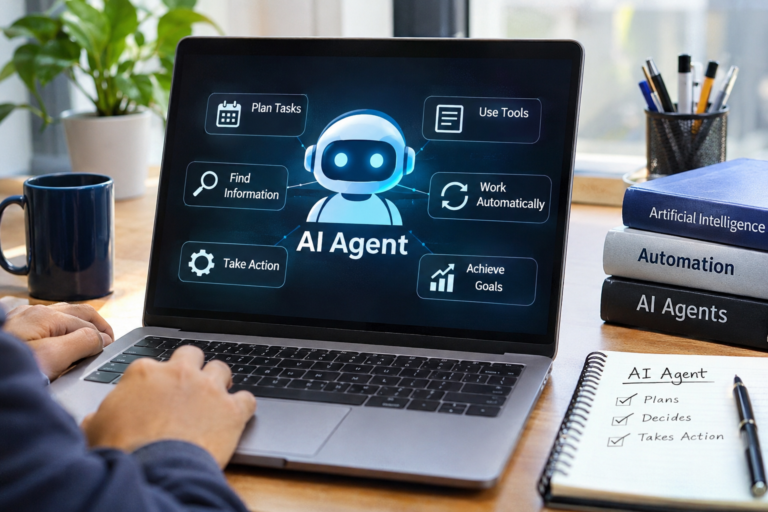

Artificial intelligence has come a long way from simply answering questions and generating text. Today, AI is beginning to do something much more interesting: it can understand a goal, create a plan, make decisions and take action to complete a task.
Imagine asking an AI system to organize a business meeting. Instead of just suggesting a suitable schedule, it could check available calendar slots, identify participants, prepare an agenda, send invitations and remind everyone before the meeting.
This is the idea behind Agentic AI.
Unlike traditional AI tools that mainly respond to instructions, Agentic AI systems are designed to work towards specific goals. They can break complicated tasks into smaller steps, use external tools, evaluate results and adjust their approach when something does not go as expected.
But how does this actually work? How can an AI system decide what to do next? And does Agentic AI really have the ability to operate independently?
Let’s explore the technology, its working process, practical applications and limitations in simple terms.
What Is Agentic AI?
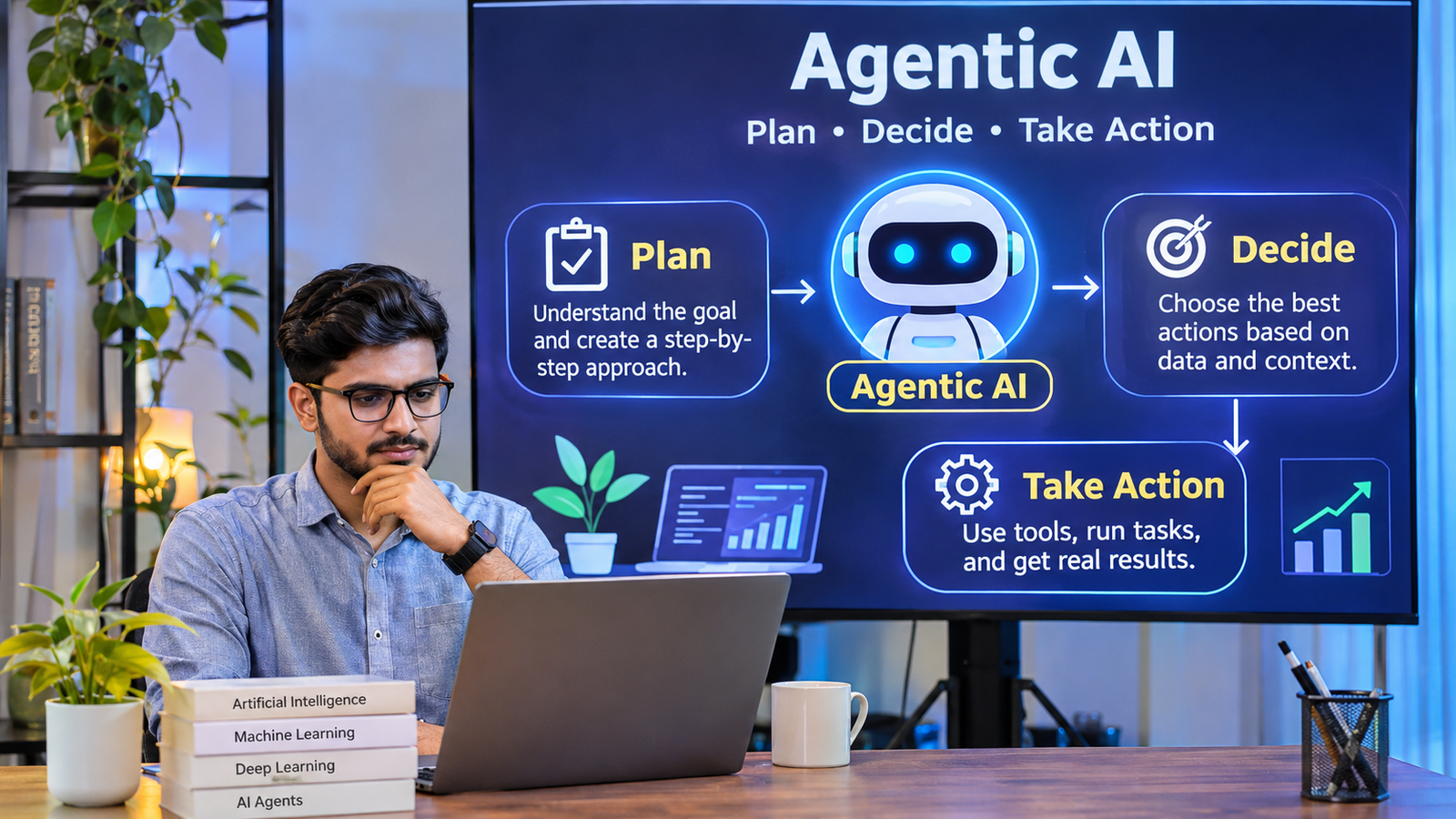
Agentic AI refers to artificial intelligence systems designed to pursue goals by planning tasks, making decisions and taking actions with a certain degree of independence.
The word agentic comes from agency, which means having the ability to act and influence outcomes.
A traditional chatbot usually waits for a question and generates a response. An Agentic AI system, on the other hand, can receive a goal and determine the steps required to achieve it.
For example:
- Traditional AI: “Find me some good hotels in Jaipur.”
- Agentic AI: Understands your budget, searches for suitable hotels, compares available options, checks important details and prepares recommendations. If authorized, it may also proceed with a booking.
The important difference is that Agentic AI does not necessarily stop after generating an answer. It can interact with other systems and perform multiple actions to complete a task.
However, its independence depends on the permissions, tools, instructions and safeguards provided by its developers.
How Does Agentic AI Work?
Agentic AI works through a continuous process of understanding, planning, acting and evaluating.
It does not simply generate one response and finish. Instead, it can move through several stages until it reaches the desired result or determines that it needs human assistance.
1. Goal Understanding
The first step is understanding what the user actually wants.
For example, if someone says, “Prepare a weekly sales report,” the AI needs to identify what information is required, where the data might be stored and what the final report should contain.
It may need to consider:
- The expected result.
- Available information.
- User preferences and instructions.
- Any restrictions or deadlines.
A clear understanding of the goal helps the system avoid unnecessary actions.
2. Planning the Steps
Once the goal is understood, the AI creates a sequence of smaller tasks.
For a weekly sales report, the plan might look like this:
- Access the sales database.
- Collect the latest sales figures.
- Compare current results with the previous week.
- Identify important changes.
- Prepare charts and summaries.
- Generate the final report.
This ability to break a larger objective into manageable tasks is one of the important characteristics of Agentic AI.
3. Decision-Making
Planning alone is not enough. The system also needs to decide what to do at different stages.
Suppose the AI is collecting sales information but discovers that some records are missing.
It may decide to:
- Check another approved data source.
- Retry the original request.
- Exclude incomplete records and explain the limitation.
- Ask a human for clarification.
These decisions are influenced by the system’s instructions, available information, reasoning capabilities and permitted actions.
4. Taking Action
After deciding what needs to happen, the AI uses available tools to perform the required tasks.
Depending on its configuration, it may interact with:
- APIs and databases.
- Websites and web applications.
- Email platforms.
- Business software.
- File storage systems.
- Scheduling applications.
For example, an AI agent working on customer support might look up an order, check its delivery status, prepare a response and update a support ticket.
Actions involving money, sensitive information or important business decisions should have suitable permission checks and human approval.
5. Evaluating the Results
A useful Agentic AI system does not simply assume that every action was successful.
It checks the outcome and compares it with the original goal.
If something fails, the system may try another permitted approach, revise its plan or request human assistance.
What Makes Agentic AI Different from Traditional AI?
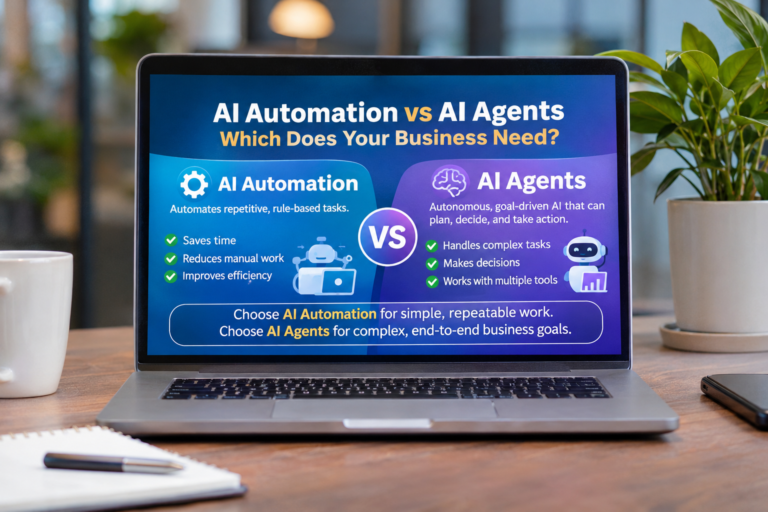
Not every AI system is an AI agent. Understanding the difference is important when choosing technology for a business or project.
Traditional AI applications are often designed to perform specific tasks, such as answering questions, classifying information or generating content.
Agentic AI focuses more on achieving an objective through multiple connected actions.
Here is a simple comparison:
| Feature | Traditional AI | Agentic AI |
|---|---|---|
| Main purpose | Respond to requests | Complete goals |
| Planning | Usually limited | Can create multi-step plans |
| Decision-making | Often predefined | Can select actions based on context |
| Tool usage | Depends on integration | Can coordinate multiple tools |
| Task execution | Usually individual tasks | Can manage connected tasks |
| Adaptability | Varies by application | Can revise plans based on results |
| Human involvement | Instructions and review | Supervision and approval when needed |
One important point: Agentic AI is not automatically more intelligent than traditional AI. Its main distinction is the way it organizes and executes work.
Real-World Applications of Agentic AI
Agentic AI is becoming relevant across different industries. Its biggest potential is in situations where completing a task requires several connected activities rather than one simple response.
1. Customer Support and Service
Customer Service Automation: Top 6 AI Answer Platforms – AI CERTs News
Customer support teams receive hundreds or thousands of requests. Managing every request manually can take considerable time.
An Agentic AI system can help by:
- Understanding incoming customer messages.
- Identifying the issue.
- Retrieving relevant order information.
- Checking available solutions.
- Preparing responses.
- Updating support records.
For example, when a customer asks about a delayed delivery, the agent can check the order status and provide an appropriate update.
More complicated complaints can be transferred to a human support representative.
2. Business Process Automation
AI Workflow Automation for Operations Teams: A Practical Implementation Guide | Marathon Insights
Businesses often perform repetitive activities across different departments.
These activities may include preparing reports, managing documents, processing requests and coordinating internal communication.
Agentic AI can connect multiple steps into one workflow.
For example, when a new business inquiry arrives, an agent could collect the customer’s details, categorize the request, create a CRM entry and notify the appropriate sales representative.
This can reduce manual work and improve response times.
3. Software Development
Software development is another area where Agentic AI can be useful.
An AI coding agent may be instructed to fix a particular issue in an application.
It can potentially:
- Examine the existing code.
- Identify the source of an error.
- Suggest or implement a correction.
- Run relevant tests.
- Review the results.
- Report any remaining problems.
Developers still need to inspect the changes, especially when applications involve security, payments or sensitive information.
4. Marketing and Content Management
Marketing requires coordination between research, content creation, publishing and performance analysis.
An Agentic AI workflow could help a marketing team by researching a topic, preparing content ideas, creating draft articles, organizing publishing schedules and summarizing campaign performance.
For example, a business could assign an agent the goal of preparing a monthly content calendar.
The agent might research relevant subjects, organize them into categories and prepare a suggested publishing plan.
Human review remains important for accuracy, brand voice and originality.
5. E-commerce and Online Shopping
Latest ERP Trends, Tech Insights & Business Solutions | Futuresol
Online stores manage product listings, inventory, customer inquiries, orders and returns.
Agentic AI can assist with several connected activities.
For example, when inventory reaches a predefined level, an agent could check stock records, prepare a purchase request and notify the purchasing team.
It could also help customers find suitable products based on their requirements.
However, actual purchases, refunds and price changes should follow clearly defined authorization rules.
What Technologies Make Agentic AI Possible?
Agentic AI is not a single technology. It combines several components that work together to help an AI system understand instructions and perform tasks.
Here are the major building blocks.
1. Large Language Models (LLMs)
Large Language Models provide much of the language understanding and reasoning capability used in modern AI agents.
They help systems understand user instructions, interpret information, generate plans and select possible next steps.
Examples include models from OpenAI, Anthropic and Google.
An LLM alone is not necessarily an AI agent. It becomes part of an agentic system when connected to planning, tools, memory and execution capabilities.
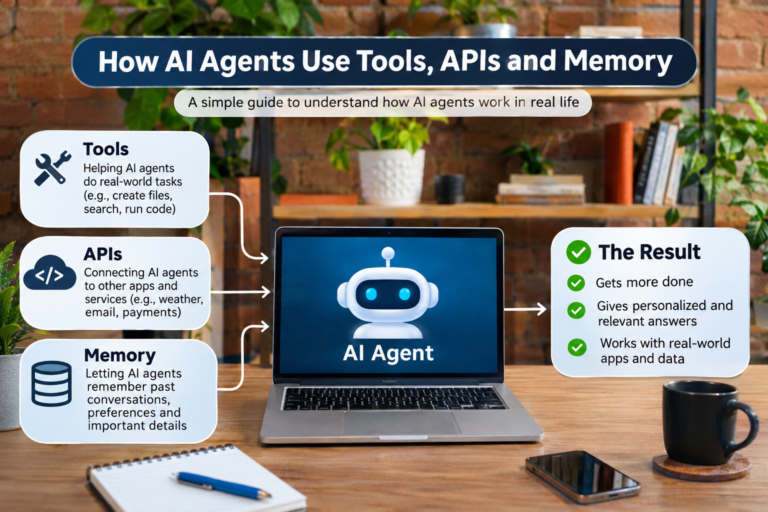
2. Tools and APIs
Tools allow AI agents to interact with external applications and services.
For example:
- A search tool retrieves information.
- A calculator performs numerical operations.
- An email API helps manage messages.
- A database connection retrieves business records.
- A calendar API manages scheduled events.
Without tools, an AI system may only be able to generate suggestions rather than perform the requested activities.
3. Memory
Memory helps an agent retain relevant information during a task or across supported interactions.
There are generally two useful categories:
Short-term memory: Information about the current task, previous steps and recent observations.
Long-term memory: Relevant information retained for future tasks, such as established preferences or previously stored business knowledge.
Memory must be managed carefully. Sensitive information should not be retained unnecessarily, and systems should respect access permissions and data protection requirements.
4. Planning and Reasoning
Planning helps the agent determine how to approach a task.
Reasoning capabilities help it evaluate available information, compare possible actions and select a suitable next step.
For complex tasks, an agent may need to revise its plan several times as new information becomes available.
5. Feedback and Evaluation
Feedback allows an agent to determine whether its actions produced the expected outcome.
This may involve checking a database record, verifying a successful API response or running a software test.
A reliable system should distinguish between an action being attempted and an action being successfully completed.
Agentic AI vs AI Agents: Are They the Same?
These terms are closely related, but they are not exactly interchangeable.
Agentic AI describes the broader approach or capability of AI systems that can pursue goals, make decisions and take actions.
An AI agent is an individual system or software component designed to perform tasks using those capabilities.
Think of it this way:
- Agentic AI is the overall concept.
- An AI agent is a practical implementation of that concept.
- A multi-agent system uses multiple agents that cooperate or coordinate to achieve a larger objective.
For example, an online business might use one agent for customer support, another for inventory management and another for sales reporting.
Together, they can form a larger agentic workflow.
What Are Multi-Agent AI Systems?
Sometimes a single AI agent is not the best way to handle a complicated task.
A multi-agent system divides responsibilities among several specialized agents.
Imagine a company wants to prepare a detailed market research report.
Different agents could perform different responsibilities:
- Research Agent: Collects relevant market information.
- Data Analysis Agent: Examines available data and identifies trends.
- Writing Agent: Organizes the findings into a report.
- Review Agent: Checks the report for missing information and inconsistencies.
A coordinating system can assign work, exchange results and combine the output.
AI Agent Orchestration System Managing Multiple Autonomous AI Agents
This approach can make complex workflows easier to organize, although coordination introduces additional costs, complexity and opportunities for errors.
Benefits of Agentic AI
Agentic AI offers several potential advantages when implemented correctly.
1. Reduced manual effort
Agents can handle repetitive activities that otherwise require employees to move between multiple applications.
2. Better workflow coordination
They can connect different steps of a process instead of treating every task as an isolated activity.
3. Faster task completion
Some workflows can be completed more quickly because agents can perform several permitted activities without requiring a human to initiate every individual step.
4. Greater flexibility
An agent can sometimes change its approach when the original plan encounters an unexpected problem.
5. Improved availability
Software agents can operate outside normal office hours when their infrastructure, permissions and monitoring allow it.
6. Support for growing businesses
Small teams can use agentic workflows to manage more operational tasks without immediately expanding their workforce.
These benefits are not guaranteed. They depend on the quality of the system, the task being automated and the level of human oversight.
Challenges and Limitations of Agentic AI
Despite its potential, Agentic AI still has important limitations.
It is worth understanding these before introducing agents into important business operations.
1. Incorrect Decisions
AI models can misunderstand instructions or interpret information incorrectly.
If an agent makes a poor decision, that mistake may affect several later steps in the workflow.
2. Security and Privacy Risks
Agents may access business applications, customer information and internal databases.
Poorly designed permissions can create security problems.
Organizations should use restricted access, secure authentication and activity monitoring.
3. Unexpected Costs
An agent may perform multiple model requests, API calls and tool operations while completing a task.
Without suitable limits, complex workflows can become expensive.
4. Lack of Complete Reliability
Agents can encounter unavailable websites, failed API requests, incorrect information and unexpected application behavior.
They need error handling, testing and clear stopping conditions.
5. Human Supervision Is Still Important
Not every decision should be delegated to an AI system.
Financial transactions, legal commitments, sensitive customer communication and important business decisions may require human approval.
6. Data Quality Problems
If an agent receives outdated or inaccurate information, its decisions may also be unreliable.
Good data management is essential for successful implementation.
How to Build a Basic Agentic AI System
You do not necessarily need to build a complex AI platform to understand how agentic systems work.
A simple project can demonstrate the main concepts.
For example, consider building an AI agent that helps manage customer inquiries.
Step 1: Define a clear goal
Decide exactly what the agent should accomplish.
Example: Categorize incoming customer inquiries and prepare suitable response drafts.
Step 2: Select an AI model
Choose a language model that can understand customer messages and generate useful responses.
Step 3: Connect the required tools
Provide access to approved resources, such as a customer database or support platform.
Step 4: Create the workflow
Define how the agent should receive a message, identify the issue, retrieve information and prepare a response.
Step 5: Add memory where necessary
Allow the system to retain relevant information during the customer interaction.
Step 6: Establish safety rules
Define what the agent can do independently and which activities require approval.
Step 7: Test different situations
Try normal requests, incomplete information, unusual questions and failed tool connections.
Step 8: Monitor performance
Track accuracy, response quality, task completion rates and operational costs.
Once the system performs reliably in a controlled environment, it can be introduced into a real workflow gradually.
Popular Agentic AI Frameworks and Platforms
Developers have several options for building agentic systems. The right choice depends on the project, programming experience and technical requirements.
Some platforms and frameworks worth exploring include:
- LangGraph: Useful for building stateful agent workflows with explicit control over execution.
- CrewAI: Designed for coordinating multiple specialized AI agents.
- AutoGen: A framework for creating applications involving conversations and collaboration between AI agents.
- OpenAI Agents SDK: Provides tools for building agent applications with tool usage, handoffs and tracing.
- n8n: A workflow automation platform that can connect applications and incorporate AI-powered steps.
These tools serve somewhat different purposes. Some emphasize workflow control, others focus on multi-agent collaboration or integrations.
Before selecting one, consider documentation, maintenance, security, deployment requirements and total operating cost.
What Is the Future of Agentic AI?
Agentic AI is likely to become an increasingly important part of business software and digital services.
Rather than opening separate applications for every activity, users may increasingly interact with systems that coordinate several tools through a single instruction.
For example, a business owner might ask an AI system to prepare a weekly operational summary. The system could collect approved sales data, review customer inquiries, summarize outstanding tasks and prepare a report.
However, the future of Agentic AI will not depend only on how independently these systems can operate.
Reliability, transparency, security and human control will be equally important.
Businesses that introduce AI agents with clear responsibilities and measurable outcomes are more likely to benefit than those that automate everything without proper planning.
Frequently Asked Questions (FAQs)
1. What is Agentic AI in simple words?
Agentic AI is an approach to artificial intelligence in which systems can understand a goal, plan the necessary steps, make decisions and perform actions using available tools.
2. Can Agentic AI work without human involvement?
Yes, certain tasks can be completed with limited human involvement. However, the level of independence depends on the system’s permissions, design and safety controls. Important decisions may still require human approval.
3. Is ChatGPT an example of Agentic AI?
ChatGPT is primarily an AI assistant, but it can also support agentic workflows when equipped with tools and capabilities that allow it to plan and perform multi-step tasks. Not every conversation with ChatGPT is an agentic workflow.
4. Does Agentic AI require coding?
Not always. Some no-code and low-code platforms allow users to create basic agentic workflows without extensive programming knowledge. More advanced applications generally require development skills.
5. What is the difference between Agentic AI and generative AI?
Generative AI focuses on creating content such as text, images, audio and code. Agentic AI focuses on pursuing goals through planning, decision-making and action. An agentic system may use generative AI as one of its core components.
6. Can Agentic AI replace employees?
Agentic AI can automate certain repetitive activities and support employees with complex workflows. However, human judgment, communication, accountability and domain expertise remain important. It is more realistic to view it as a technology that can change job responsibilities rather than automatically replace entire teams.
7. Is Agentic AI safe for businesses?
It can be used safely when organizations implement proper access controls, testing, monitoring, data protection and human approval processes. Giving an AI agent unrestricted access to business systems is not recommended.
Conclusion
Agentic AI represents an important development in how artificial intelligence systems interact with the digital world.
Instead of simply answering questions, these systems can work towards specific objectives by understanding instructions, creating plans, making decisions, using tools and checking their results.
Its practical value comes from connecting multiple activities into a coordinated workflow. From customer service and software development to business operations and e-commerce, Agentic AI offers opportunities to reduce repetitive work and improve productivity.
However, successful implementation requires more than connecting an AI model to a few tools. Businesses need clear objectives, reliable data, appropriate permissions, proper testing and human supervision.
The real opportunity is not to make AI do everything independently. It is to build systems that know what they are allowed to do, understand when they need help and consistently deliver useful results.
That is what makes Agentic AI worth paying attention to.
About the Author