
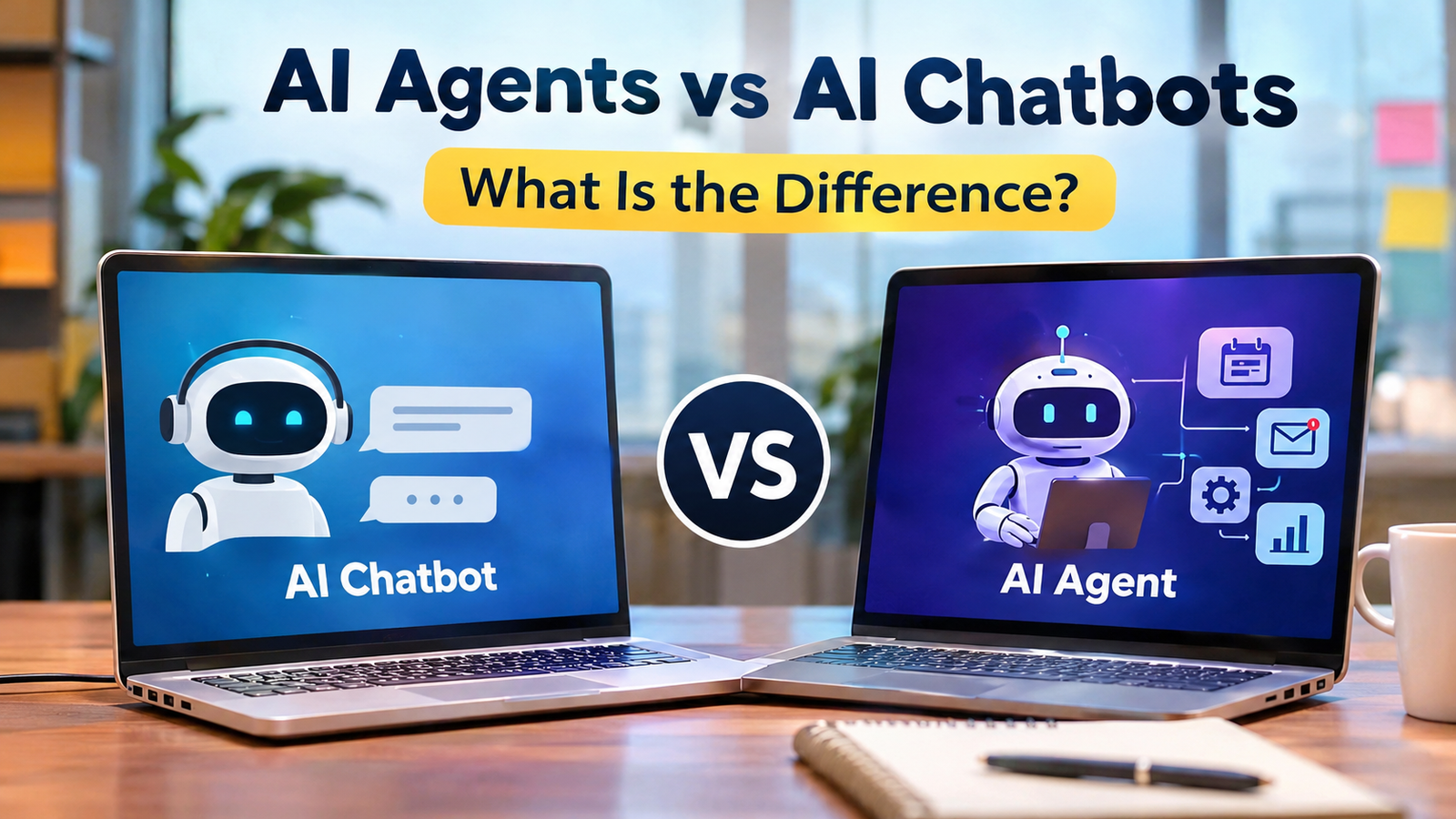
Artificial intelligence is changing the way people interact with technology. From answering everyday questions to managing business operations, AI-powered tools are becoming an important part of our digital lives.
Two terms that are frequently discussed are AI Agents and AI Chatbots. Although they may sound similar, they serve different purposes.
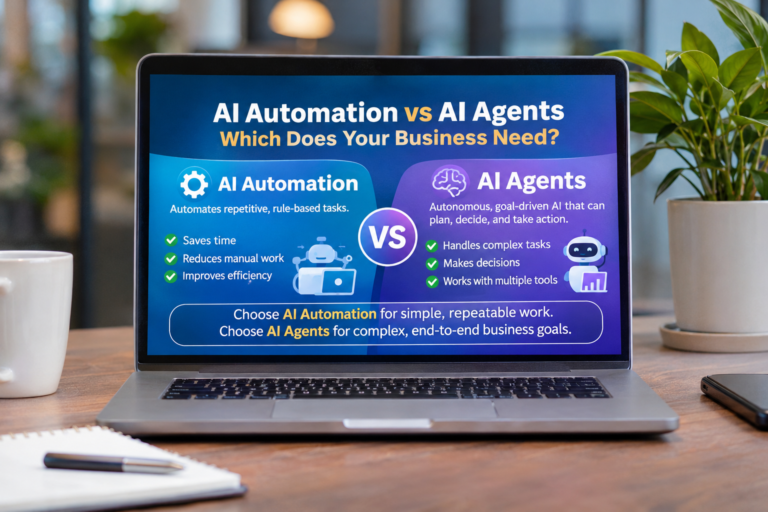
An AI chatbot mainly communicates with users, answers questions, and provides information. An AI agent can go a step further by understanding a goal, making decisions, using tools, and completing tasks with varying levels of independence.
But does that mean AI agents are always better than chatbots? Not necessarily.
In this article, we will explore the differences between AI agents and AI chatbots, understand how they work, look at practical examples, and discover which technology is suitable for different business needs.
1. What Is an AI Chatbot?
An AI chatbot is a software application designed to communicate with people through text or voice.
It understands user questions and generates relevant responses using artificial intelligence and natural language processing.
Unlike traditional chatbots that depend heavily on predefined scripts, modern AI chatbots can understand context, handle follow-up questions, and generate more natural conversations.
For example, imagine visiting an online shopping website and asking:
“Can you recommend a laptop under ₹50,000 for programming?”
The chatbot can understand your requirements, suggest suitable laptops, explain their features, and answer additional questions.
However, unless it has been connected to shopping tools and given permission to perform actions, it will generally stop at providing information.
Common uses of AI chatbots:
- Answering customer questions.
- Providing product recommendations.
- Handling frequently asked questions.
- Assisting website visitors.
- Explaining services and pricing.
- Helping users understand complicated topics.
- Providing basic technical support.
Popular examples include ChatGPT, Google Gemini, and Microsoft Copilot.
2. What Is an AI Agent?
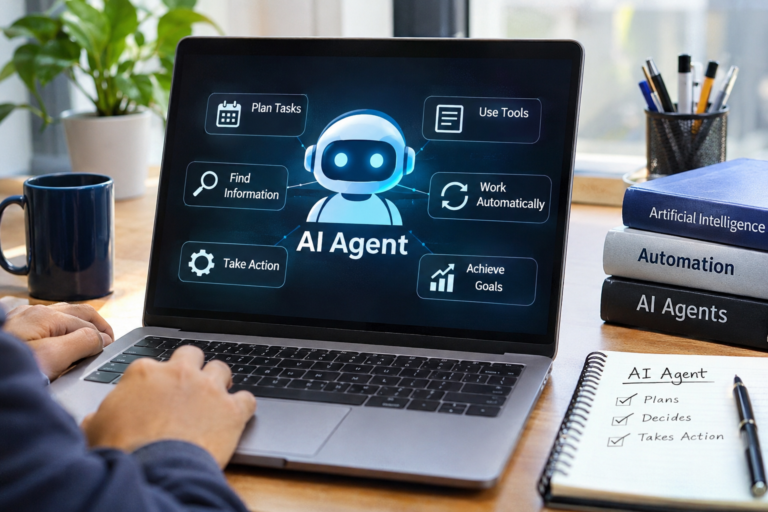
An AI agent is an artificial intelligence system designed to work towards a particular objective.
Instead of simply responding to questions, it can plan steps, make decisions, use external tools, retrieve information, and perform actions to achieve a goal.
Think about running an online business.
Suppose you want to manage customer enquiries, organize orders, and prepare daily sales reports.
A basic chatbot might explain how to perform these activities.
An AI agent, when properly configured with the necessary integrations and permissions, could:
- Read incoming customer enquiries.
- Identify what each customer needs.
- Check order information through an API.
- Prepare an appropriate response.
- Update a customer support system.
- Generate a summary of unresolved enquiries.
This is what makes AI agents different. They can move beyond conversations and participate in actual workflows.
Common uses of AI agents:
- Automating repetitive business tasks.
- Managing customer support workflows.
- Researching information from multiple sources.
- Organizing appointments.
- Processing structured business information.
- Monitoring specific events.
- Connecting different software applications.
An AI agent can operate independently within defined boundaries, but its capabilities depend on the tools, permissions, instructions, and safeguards provided to it.
3. AI Agents vs AI Chatbots: Key Differences
The biggest difference between these technologies is their primary purpose.
A chatbot is generally designed to communicate, whereas an AI agent is designed to accomplish tasks.
Here is a practical comparison:
| Feature | AI Chatbot | AI Agent |
|---|---|---|
| Main purpose | Communication | Task completion |
| Primary function | Answers questions | Works towards goals |
| Decision-making | Usually limited | Can make task-related decisions |
| Tool usage | Optional | Often uses external tools |
| Planning | Usually limited | Can plan multiple steps |
| Task execution | Usually responds | Can perform actions |
| Automation | Limited or integrated | Often a central capability |
| Human involvement | User-led conversations | Can work with less supervision |
| Complexity | Generally simpler | Often more complex |
| Best suited for | Conversations and support | Multi-step workflows |
One important point: these are general differences, not strict technical rules. Modern chatbots can also use tools, while some AI agents may require frequent human approval.
4. How Do AI Chatbots Work?
AI chatbots generally follow a conversation-based process.
Healthcare Chatbot Development Guide to Stay Compliant in 2026
The process usually involves four stages:
Step 1: User asks a question
A person enters a message or speaks a question into the chatbot.
Step 2: Understanding the message
The AI model processes the message and identifies its meaning, context, and intent.
Step 3: Generating a response
The chatbot uses its underlying AI model and available information to prepare a relevant answer.
Step 4: Displaying the response
The generated answer is presented to the user.
For example:
User: “What are your business hours?”
Chatbot: “Our business operates from 9 AM to 6 PM, Monday to Saturday.”
The entire interaction focuses on understanding the question and providing an appropriate response.
5. How Do AI Agents Work?
AI agents follow a more action-oriented process.
What Is an AI Agent? (And What AI Agents Mean for Your Brand’s Visibility)
Although implementations differ, a typical AI agent follows these stages:
Step 1: Receive a goal
The user gives the agent an objective.
Example: “Prepare a report of this week’s customer enquiries.”
Step 2: Understand and plan
The agent identifies what information it needs and determines the steps required to complete the task.
Step 3: Select the necessary tools
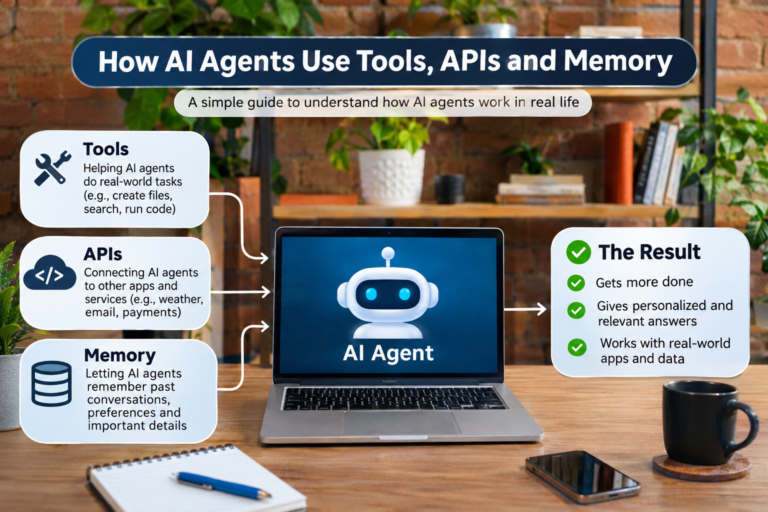
It may use APIs, databases, spreadsheets, email systems, or other connected applications.
Step 4: Perform actions
The agent retrieves information, processes it, and carries out the permitted operations.
Step 5: Review the results
It checks whether the task has been completed successfully. If something is missing, it may take another step.
Step 6: Deliver the outcome
Finally, it provides the report or result to the user.
This process allows AI agents to handle tasks that involve multiple operations rather than just answering individual questions.
6. Real-Life Examples: Where Are They Used?
Let’s understand the difference through some everyday business situations.
Example 1: Customer Support
AI Chatbot
A customer asks about a refund policy. The chatbot explains the policy and provides instructions for requesting a refund.
Customer Support Automation: A Complete Guide for Support Teams – YourGPT Blog
AI Agent
An authorized agent can check the order, verify refund eligibility, prepare a refund request, and send it for approval or process it if permitted.
Example 2: Online Shopping
- AI Chatbot: Helps customers find products based on their preferences and budget.
- AI Agent: Can search product inventory, compare available options, prepare a cart, and potentially place an order after receiving the required authorization.
Example 3: Education
- AI Chatbot: Explains mathematical problems, answers academic questions, and helps students understand concepts.
- AI Agent: Can create a study schedule, organize learning resources, track completed activities, and send reminders through connected tools.
Example 4: Business Management
- AI Chatbot: Answers questions about company services, policies, and business information.
- AI Agent: Can collect business data, prepare reports, organize tasks, and coordinate workflows across connected applications.
7. Can an AI Chatbot Become an AI Agent?
Yes. A chatbot can become part of an AI agent system when it is connected to additional capabilities.
For example, imagine a website chatbot that initially only answers questions.
You can extend its functionality by connecting it with:
- A customer database.
- Email services.
- Appointment scheduling software.
- Payment systems.
- Business APIs.
- Task management applications.
Now, instead of only answering questions, the system may also perform specific tasks.
However, simply connecting an API does not automatically make a chatbot a capable agent. It also needs appropriate instructions, decision-making logic, task management, and permission controls.
This is why many modern AI applications combine conversational interfaces with agent-like capabilities.
8. Advantages and Limitations of AI Chatbots
Advantages
- Easy to implement for common questions.
- Available around the clock.
- Can handle multiple conversations.
- Improves customer response times.
- Reduces repetitive support work.
- Provides a convenient communication channel.
Limitations
- May struggle with complicated multi-step tasks.
- Can generate incorrect information.
- May lack access to real-time business data.
- Usually requires additional integrations to perform actions.
- Complex customer problems may still require human assistance.
9. Advantages and Limitations of AI Agents
Advantages
- Can complete multi-step workflows.
- Connects different business applications.
- Reduces repetitive manual operations.
- Can work towards specific objectives.
- Helps organize and process large amounts of information.
- Can operate with limited supervision when properly configured.
Limitations
- More difficult to design and maintain.
- Requires reliable tools and integrations.
- Can make incorrect decisions or take unintended actions.
- May increase operational and API costs.
- Needs security controls and permission management.
- Important decisions may still require human approval.
AI agents should not be given unlimited access to sensitive business systems. Financial transactions, customer data, account changes, and other high-impact operations should have appropriate approval mechanisms.
10. Which Is Better for Your Business: AI Agents or AI Chatbots?
The answer depends on what you want to achieve.
Not every business needs an advanced AI agent. Sometimes, a well-designed chatbot is enough to solve the problem.
Consider the following situations:
| Business requirement | Recommended solution |
|---|---|
| Answering website visitors | AI Chatbot |
| Explaining products and services | AI Chatbot |
| Handling common questions | AI Chatbot |
| Checking order information | Chatbot with integrations or AI Agent |
| Managing multiple business tasks | AI Agent |
| Preparing automated reports | AI Agent |
| Coordinating different applications | AI Agent |
| Managing complex workflows | AI Agent |
My recommendation: Start with a chatbot if your primary requirement is customer communication. Consider an AI agent when you need to automate processes that involve multiple steps, tools, and decisions.
You can also combine both technologies to create a system that communicates with customers and performs business tasks behind the scenes.
11. How to Get Started with AI Agents and Chatbots
You do not need to build everything from scratch.
There are several platforms that make it easier to experiment with these technologies.
Introducing Voiceflow’s New Look | Pathways
Voiceflow
Useful for designing conversational experiences and customer-facing AI assistants.Explore Voiceflow
n8n Logo PNG Vector, Icon Free Download
n8n
Helps connect applications, APIs, and AI models to build automated workflows.Explore n8n
Botpress – Generative AI Platform for Building ChatGPT Chatbots – ToolPilot
Botpress
Provides tools for building AI-powered chatbots and conversational agents.Explore Botpress
File:LangChain Logo.svg – Wikimedia Commons
LangChain
Useful for developers interested in building AI applications with tools, integrations, and agent workflows.Explore LangChain
A good starting approach is to identify one repetitive task, build a small prototype, test it with real scenarios, and gradually add more capabilities.
12. The Future of AI Agents and AI Chatbots
The distinction between AI agents and chatbots is becoming less obvious as AI technology develops.
Modern AI assistants are increasingly capable of combining natural conversations with external tools and task execution.
In the coming years, businesses may use a single AI interface that can answer questions, retrieve information, organize work, and execute approved actions.
For example, a business owner might simply ask:
“Show me yesterday’s sales, identify pending customer orders, and prepare a summary for my team.”
An AI-powered system could coordinate several connected tools to complete these activities.
However, more automation does not necessarily mean better results. Accuracy, privacy, security, transparency, and human oversight will remain important.
Conclusion
AI agents and AI chatbots are both useful technologies, but they solve different problems.
An AI chatbot focuses primarily on communication, helping users find information, answer questions, and receive assistance.
An AI agent focuses on achieving objectives by planning tasks, using tools, and performing actions within defined permissions.
The best choice depends on your requirements. If you want to improve customer communication, start with an AI chatbot. If you want to automate multi-step business processes, explore AI agents.
And if you want the best of both worlds, combining conversational AI with agent-based automation can be a practical way to build smarter digital experiences.
The goal should not be to use AI simply because it is popular. The goal should be to solve real problems with technology that makes work easier, faster, and more reliable.
About the Author