
Technology • Artificial Intelligence • 8–10 min read
Artificial Intelligence is changing the way people work, communicate, learn and run businesses. Over the last few years, AI chatbots have become part of everyday life. People use them to write emails, generate content, answer questions, create images and solve problems.
But a new development is attracting even more attention: AI Agents.
Unlike traditional AI chatbots that mainly respond to questions, AI agents can take things a step further. They can understand a goal, plan the steps required, use different tools, perform tasks and work towards completing an objective with limited human involvement.
Imagine telling an AI system:
“Find five potential customers for my business, research their companies, prepare personalised emails and organise the results in a spreadsheet.”
Instead of simply explaining how to do it, an AI agent may be able to carry out much of the work itself.
This is one of the biggest reasons AI agents are becoming an important topic in the technology industry.
But what exactly are AI agents? How do they work? And why are businesses, developers and professionals paying so much attention to them?
Let’s understand everything step by step.
1. What Are AI Agents?
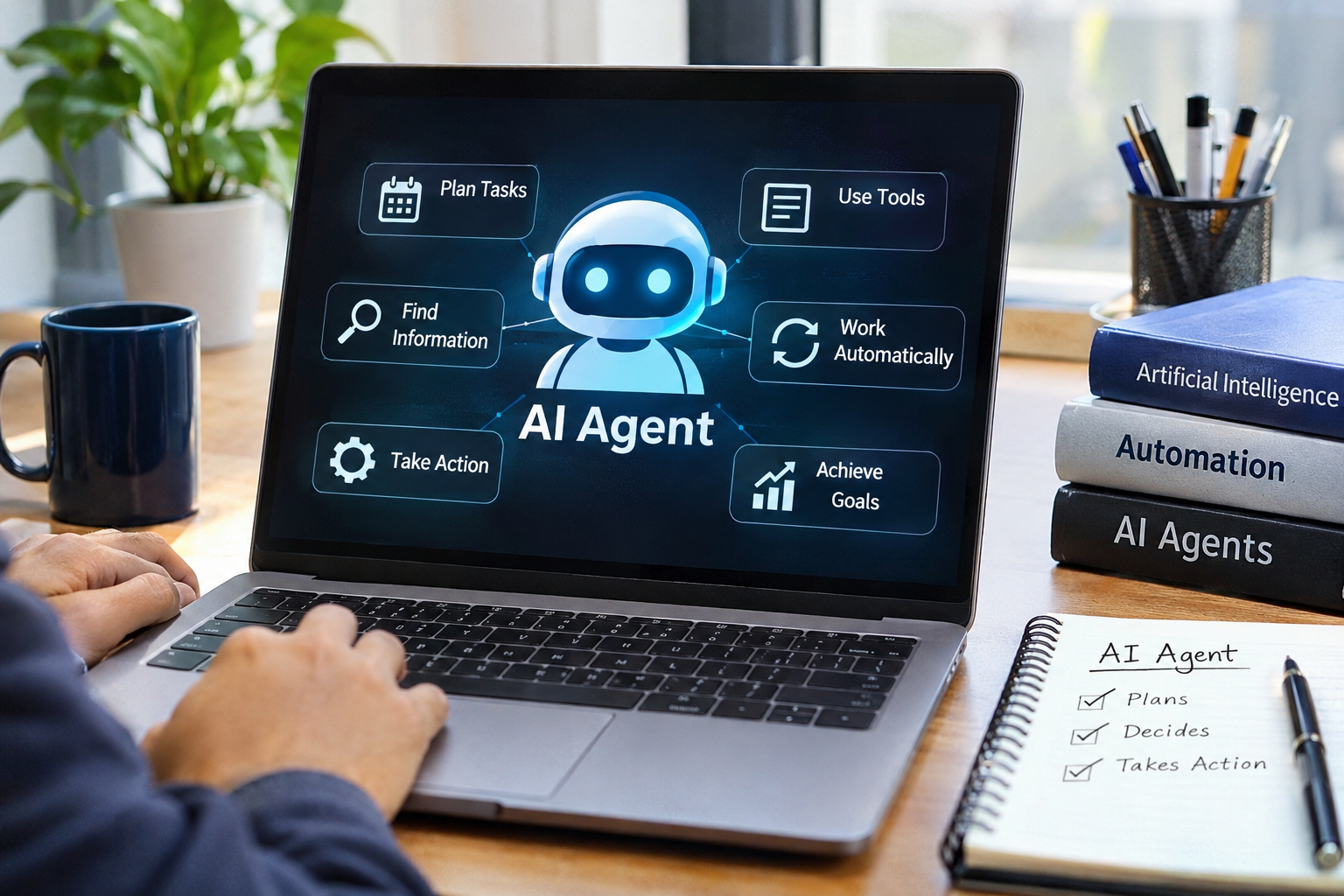
An AI agent is a software system that uses artificial intelligence to understand a goal, make decisions and perform actions to achieve that goal.
It can analyse information, plan tasks, interact with external tools and adjust its approach depending on the results it receives.
In simple words, an AI agent is like a digital assistant that doesn’t just tell you what needs to be done but can also help do the actual work.
For example, consider a normal AI chatbot.
You ask:
“How can I book a flight from Delhi to Mumbai?”
The chatbot explains the booking process and provides useful information.
Now imagine an AI agent receiving the same request.
It could potentially:
- Search for available flights.
- Compare prices and timings.
- Identify suitable options.
- Ask for your approval.
- Complete the booking through an authorised service.
- Send you the confirmation.
The important difference is that an AI agent can move from providing information to taking action.
2. How Do AI Agents Work?
AI agents combine several technologies to perform tasks. They don’t necessarily use just one AI model or one software application.
Most AI agent systems involve a few important components.
A. Understanding the Goal
First, the agent needs to understand what the user wants.
For example:
“Create a weekly content plan for my technology website.”
The agent interprets the request and identifies the expected result.
B. Planning the Tasks
After understanding the goal, the agent determines the steps required to complete it.
For example:
- Identify relevant technology topics.
- Research the latest developments.
- Select suitable blog ideas.
- Create a weekly publishing schedule.
- Organise the results in a document.
This planning process helps the agent break a large task into smaller activities.
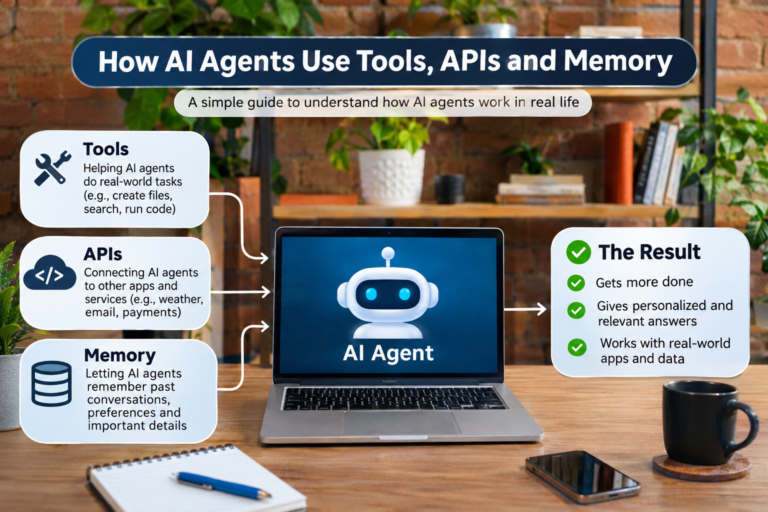
C. Using Tools
An AI agent may connect with external tools and services to perform different actions.
These could include:
- Web browsers for research.
- APIs for accessing information.
- Email services for communication.
- Databases for storing information.
- Spreadsheets for organising data.
- Calendar applications for scheduling.
Without tools, an AI model may only be able to generate responses. Tool access allows an agent to interact with external systems.
D. Taking Action
Once the agent has identified the next step and has the necessary permissions, it can perform an action.
For example, it might create a spreadsheet, organise customer information or prepare an email draft.
Some actions may require human approval before execution.
E. Checking the Results
A useful AI agent doesn’t simply perform an action and assume everything worked.
It can examine the result, identify errors and decide whether another step is necessary.
For example, if a website doesn’t load, the agent might retry or use another permitted information source.
This cycle of understanding, planning, acting and checking makes AI agents different from basic question-answering systems.
What Are AI Agents and How to Build Them [2026]
3. AI Agents vs Traditional AI Chatbots
One of the most common questions is whether AI agents and AI chatbots are the same thing.
They are related, but they are not identical.
| Feature | AI Chatbot | AI Agent |
|---|---|---|
| Main purpose | Answer questions | Achieve goals |
| Communication | Text or voice | Text, voice and tools |
| Planning | Usually limited | Can plan multiple steps |
| Tool usage | May have tool access | Often uses multiple tools |
| Actions | Mainly provides responses | Can perform authorised actions |
| Independence | Usually responds to prompts | Can continue through a workflow |
| Feedback | Provides answers | Can evaluate results and retry |
For example, a chatbot can explain how to organise your inbox.
An AI agent with appropriate email permissions could identify messages, categorise them and prepare actions based on your instructions.
However, modern chatbots can also have agent-like capabilities. The distinction is not always a strict separation between two products. It is more about how much planning, tool use and autonomous action a system can perform.
4. Why Is Everyone Talking About AI Agents?
AI agents are receiving attention because they could change how people interact with software and complete everyday work.
Here are some of the biggest reasons.
1. They Can Reduce Repetitive Work
Many businesses spend hours performing repetitive activities.
Examples include:
- Collecting information.
- Preparing reports.
- Organising customer records.
- Responding to common enquiries.
- Updating spreadsheets.
- Managing routine workflows.
AI agents can help automate many of these activities.
This allows employees to spend more time on decision-making, creativity and important business operations.
2. They Can Work Across Multiple Applications
Traditionally, people switch between several applications to complete a task.
For example, preparing a customer report might involve opening a CRM, checking emails, researching information and updating a spreadsheet.
An AI agent can potentially connect these applications and coordinate the workflow.
This is particularly useful when a task involves multiple steps and different software platforms.
3. Businesses Want Greater Productivity
Companies are constantly looking for ways to improve productivity without unnecessarily increasing operational costs.
AI agents offer an opportunity to automate certain processes, improve response times and reduce manual workloads.
For example, an online store could use an AI agent to help manage customer questions, check order information and prepare support requests.
4. AI Is Moving Beyond Conversations
Until recently, many people experienced AI primarily through chat interfaces.
Now, AI systems are increasingly being developed to interact with software, retrieve information, execute actions and manage workflows.
This shift from answering questions to completing tasks is a major reason AI agents are attracting attention.
5. Developers Can Build More Capable Applications
Developers can use AI models, APIs, databases and agent frameworks to build applications that perform more complicated tasks.
This creates opportunities for startups, software companies and independent developers.
A developer no longer needs to build every part of an intelligent workflow from scratch.
5. Real-World Examples of AI Agents
AI agents are not limited to theoretical experiments. Agent-like systems are already being used in different industries.
Here are some practical examples.
Zendesk Snaps Up AI Pioneer Forethought in Customer Service Power Play | The Tech Buzz
1. Customer Support Agents
These agents can answer common questions, retrieve order information, classify customer complaints and route complicated issues to human employees.
Grow as a Freelance Social Media Manager & Get More Clients
2. Marketing Agents
They can research topics, generate content ideas, prepare campaign drafts and analyse marketing performance.
Making Money by Web Development:. Web development | by Fahad Qayum | Medium
3. Coding Agents
They can analyse code, suggest improvements, write functions, identify bugs and help developers work through software development tasks.
Prévisionnel financier : pourquoi c’est indispensable pour lancer son activité ?
4. Business and Data Agents
They can organise information, analyse datasets, prepare reports and identify patterns that may help business owners make decisions.
Warehouse Management Guide for Inventory & Fulfillment
5. E-commerce Agents
They can assist with product information, inventory checks, order tracking and customer communication.
These examples represent possible capabilities. The actual level of automation depends on the system, available integrations, data quality and permissions.
6. Popular AI Agent Tools and Platforms
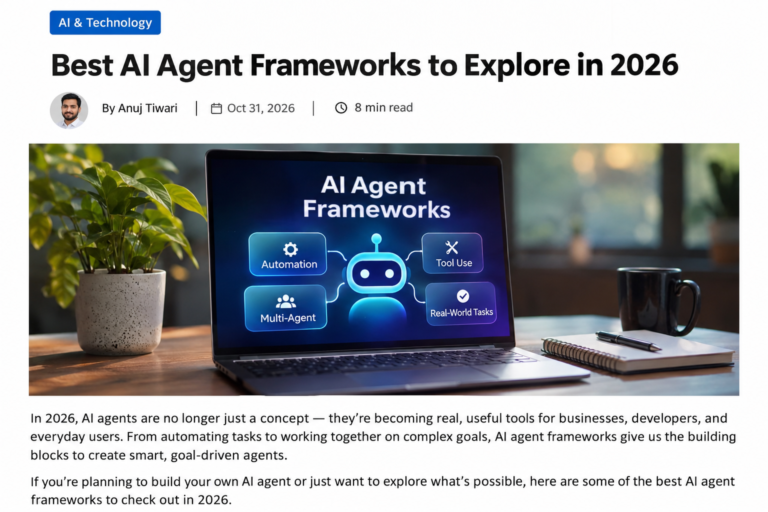
The growing interest in AI agents has encouraged technology companies to develop platforms that make agent creation easier.
Some notable tools and technologies include:
Upsurge | Sovereign Agentic Infrastructure
LangChain
A development framework for building applications powered by language models, tools and external data sources.
Website: langchain.com
Crew AI Pricing & Reviews 2025 | Techjockey.com
CrewAI
A framework focused on creating teams of AI agents that collaborate on tasks.
Website: crewai.com
Microsoft AutoGen
An open-source programming framework for developing multi-agent AI applications.
Website: Microsoft AutoGen
File:OpenAI logo 2025 (symbol).svg – Wikimedia Commons
OpenAI developer platform
Provides models and development tools that developers can use to build applications with tool calling and agent workflows.
Website: OpenAI developer documentation
n8n Integration | MeetGeek Meeting Assistant
n8n
A workflow automation platform that can connect applications, APIs and AI capabilities to build automated processes.
Website: n8n.io
Each platform has a different approach. Some are designed primarily for developers, while others offer visual workflow builders and automation features.
7. Can AI Agents Replace Human Employees?
This is probably one of the biggest questions surrounding the development of AI agents.
The short answer is that AI agents can automate certain responsibilities, but replacing entire jobs is a much more complicated matter.
Consider a customer support department.
An AI agent may be able to handle:
- Frequently asked questions.
- Basic order enquiries.
- Information retrieval.
- Routine customer requests.
However, situations involving emotional understanding, unusual complaints, sensitive decisions or complex negotiations may still require human involvement.
The same applies to marketing, programming, finance and other professional fields.
Instead of thinking that AI agents will immediately replace everyone, it is more useful to understand how they may change the nature of different jobs.
People who learn to work effectively with AI tools could have an advantage in workplaces where these technologies become common.
8. Limitations and Risks of AI Agents
Although AI agents offer exciting possibilities, they are not perfect.
There are several challenges that businesses and developers need to understand.
Incorrect decisions: AI agents can misunderstand instructions or generate inaccurate information. If they take action based on incorrect information, the consequences can be serious.
Security and privacy: Agents may access emails, documents, customer records and other sensitive information. Poorly designed permissions can create security risks.
Unexpected actions: An agent with excessive permissions may perform actions that the user did not intend.
Cost and complexity: Running AI agents can involve model usage fees, API costs, infrastructure expenses and maintenance.
Human supervision: Important decisions still need appropriate human review, particularly when they involve money, legal matters, personal information or business-critical operations.
A good AI agent system should include clear permissions, action limits, monitoring and human approval for high-impact activities.
9. How Can Beginners Start Learning About AI Agents?
You don’t necessarily need to be an experienced programmer to begin understanding AI agents.
The best approach is to start with the fundamentals and gradually build practical skills.
Here is a simple learning path.
- Understand Artificial IntelligenceLearn what AI, machine learning and large language models are and how they work.
- Explore AI ToolsExperiment with AI assistants and understand how they process instructions and generate responses.
- Learn APIs and AutomationUnderstand how different applications communicate and exchange information.
- Explore Agent FrameworksExperiment with tools such as LangChain, CrewAI or n8n.
- Build a Small ProjectCreate a simple research assistant, customer enquiry assistant or content planning agent.
- Learn Testing and SecurityTest different scenarios, manage permissions and understand when human approval is necessary.
You can start with simple projects before moving towards more advanced multi-agent systems.
10. What Does the Future of AI Agents Look Like?
AI agents could become an important part of how people use computers and business software.
Instead of opening several applications and manually performing every step, users may increasingly describe the result they want and allow AI-powered systems to coordinate parts of the work.
For example, a business owner might ask an AI assistant to prepare a weekly business report using authorised sales data, identify unusual changes and create a summary for the management team.
Similarly, developers may use coding agents to help with testing, documentation and software maintenance.
However, the future of AI agents will depend on more than just improvements in AI models.
Reliability, security, transparency, affordability and user trust will all play important roles.
The most successful systems will not necessarily be those that perform the most actions independently. They will be the ones that complete useful tasks accurately while keeping people in control.
Conclusion
AI agents represent an important development in artificial intelligence.
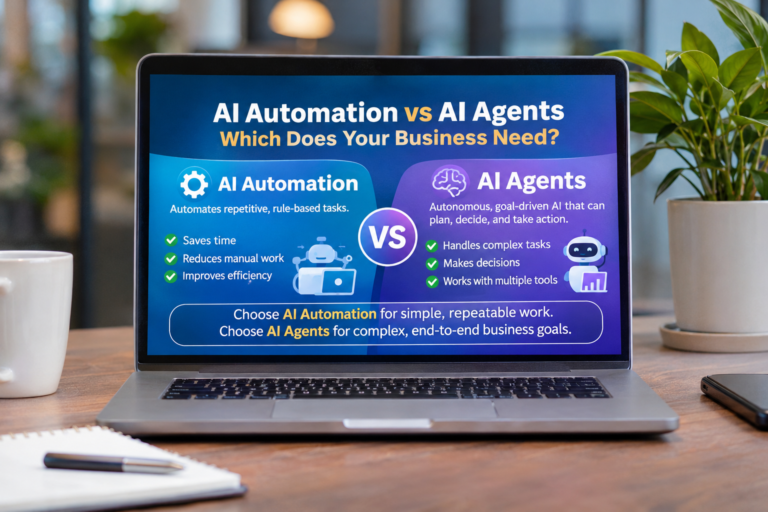
Traditional AI applications have mainly focused on understanding information and generating responses. AI agents extend these capabilities by combining reasoning, planning, tools and actions to work towards specific goals.
From customer support and marketing to software development and business automation, their potential applications are growing.
However, they are not magic solutions. They can make mistakes, require supervision and need carefully designed security controls.
For beginners, developers and business owners, this is a good time to understand how AI agents work and experiment with practical applications.
The future of AI may not be limited to asking computers questions. It may increasingly involve telling them what needs to be achieved and working alongside them to get it done.
Frequently Asked Questions (FAQs)
1. What is an AI agent in simple words?
An AI agent is a software system that understands a goal, plans tasks and uses available tools to perform actions towards achieving that goal.
2. Are AI agents and AI chatbots the same?
No. Chatbots primarily focus on conversations, while AI agents can also plan and perform tasks. However, some modern chatbots include agent-like capabilities.
3. Do AI agents require coding?
Not always. Some platforms provide visual interfaces and ready-made integrations. More advanced and customised agents usually require programming knowledge.
4. Can AI agents work without human involvement?
Some agents can complete predefined tasks independently, but human supervision is important for sensitive, high-risk or important decisions.
5. Are AI agents free to use?
Some tools offer free plans or open-source frameworks. However, using AI models, APIs, hosting and external services may involve additional costs.
6. Which programming language is useful for building AI agents?
Python is a popular choice because of its AI libraries and development ecosystem. JavaScript and TypeScript are also useful for building agent-based applications.
7. Will AI agents replace jobs?
They may automate certain tasks and change how some jobs are performed. However, the overall impact will vary across industries and professions.
About the Author