
Artificial Intelligence has changed the way people work, learn, communicate, and solve problems. From answering everyday questions to analysing large amounts of information, AI tools are becoming an important part of modern businesses.
However, traditional AI applications often depend on a single model to handle an entire task. Although this approach works well for many situations, more complicated projects may require different types of expertise, multiple steps, and continuous coordination.
This is where Multi-Agent AI Systems come into the picture.
Instead of relying on one AI model to perform every activity, a multi-agent system brings several specialised AI agents together. Each agent is assigned a particular responsibility, and all of them collaborate to achieve a shared objective.
Think of it as a team working inside an organisation. One person handles research, another prepares reports, someone analyses the information, and another checks the final result. Multi-agent AI follows a similar approach, except the team members are AI agents.
Let’s understand how these systems work, why they matter, and how they are changing the future of technology.
1. What Is a Multi-Agent AI System?
A Multi-Agent AI System is an artificial intelligence framework in which two or more independent or specialised AI agents work together to complete tasks.
Each agent can have its own instructions, tools, responsibilities, and access to information.
For example, imagine asking an AI system to prepare a detailed market research report about a new business idea.
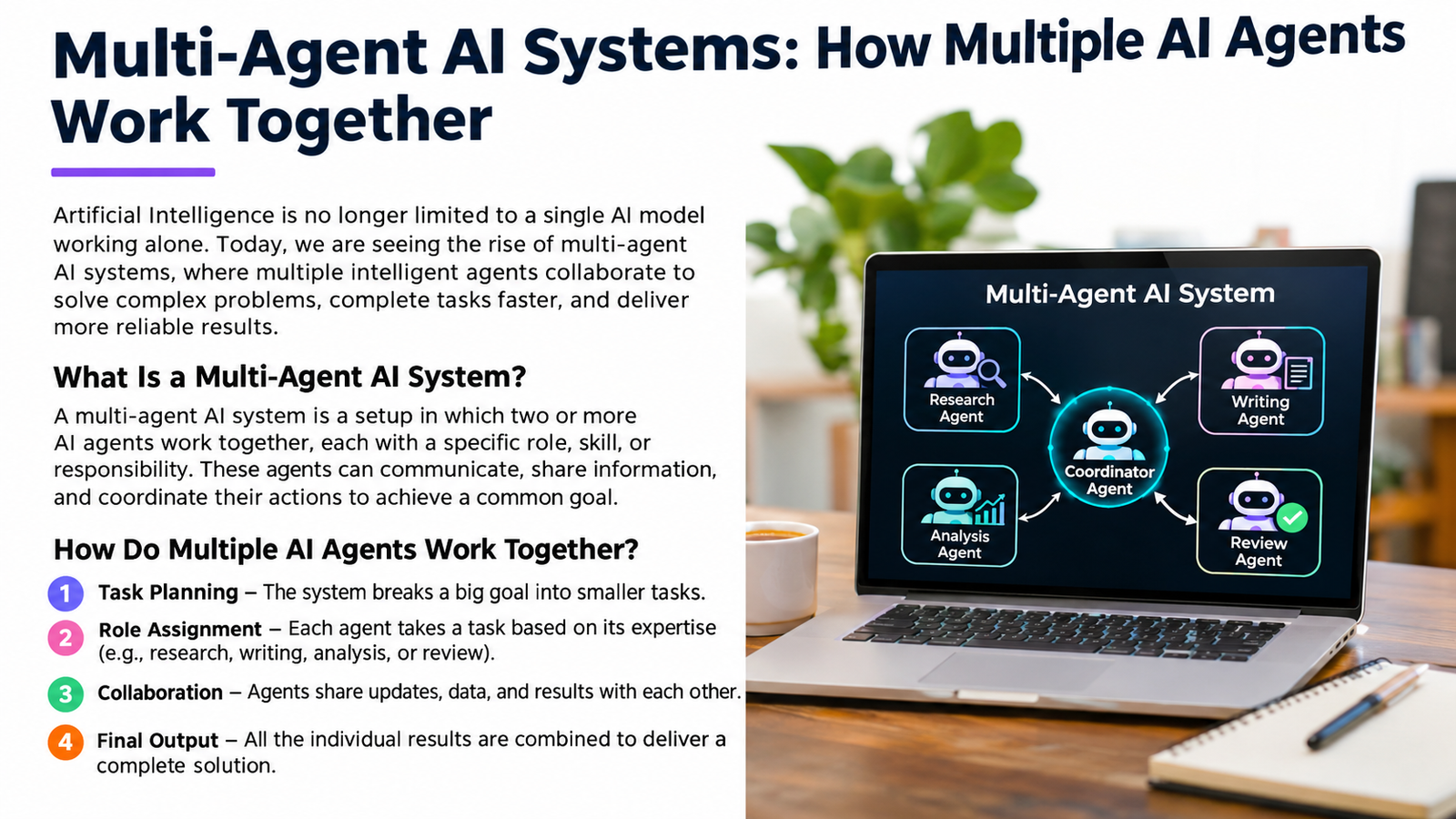
Instead of asking one AI model to do everything, the system can divide the work between different agents:
- Research Agent: Collects relevant market information.
- Analysis Agent: Studies competitors, customer behaviour, and market opportunities.
- Writing Agent: Converts the findings into a structured report.
- Review Agent: Checks the information for mistakes, missing details, and inconsistencies.
- Coordinator Agent: Assigns tasks and manages communication between the other agents.
Each agent focuses on its responsibility, and the coordinator brings everything together.
The result is a collaborative AI workflow capable of handling tasks that may be difficult for a single agent to manage efficiently.
2. How Do Multiple AI Agents Work Together?
The working process of a multi-agent system can be understood through a few important stages.
Learn to Manipulate a Text File With Python Step-by-Step | by Ajaymaurya | Medium
Step 1: Understanding the Main Objective
Everything starts when a user provides an instruction or objective.
For example:
“Create a complete business plan for launching an online clothing store.”
The system first understands what needs to be accomplished and identifies the smaller activities involved.
Step 2: Breaking the Task into Smaller Activities
A large task is divided into manageable parts.
For a business plan, these activities might include:
- Market research
- Competitor analysis
- Financial planning
- Customer identification
- Marketing strategy
- Business documentation
Breaking down the work makes it easier to distribute responsibilities.
Step 3: Assigning Responsibilities to Different Agents
The coordinator assigns each activity to an appropriate agent.
Each agent receives the necessary instructions and context to perform its task.
For example, the research agent focuses on market information, while the financial agent works on estimated costs and revenue projections.
Step 4: Communication and Collaboration
Agents exchange information, share their findings, and request additional information whenever necessary.
For instance, the financial agent may need information from the research agent to estimate the potential market size.
This communication helps different parts of the project remain connected.
Step 5: Reviewing and Combining Results
Once the individual agents complete their work, the system combines their outputs.
A review agent can identify missing information, inconsistencies, or areas that require improvement.
Finally, the coordinator prepares the combined result and presents it to the user.
3. Single-Agent AI vs Multi-Agent AI
Both approaches have their own advantages. The right choice depends on the complexity of the task.
| Feature | Single-Agent AI | Multi-Agent AI |
|---|---|---|
| Structure | One main agent | Multiple agents |
| Responsibilities | Handles several activities | Specialised responsibilities |
| Communication | Primarily user interaction | Agent-to-agent communication |
| Task management | Usually handled by one agent | Can be distributed |
| Complexity | Suitable for simpler workflows | Useful for complex workflows |
| Coordination | Less coordination required | Requires coordination |
| Resource usage | Often lower | Can be higher |
A single-agent system is not necessarily less intelligent. In fact, for many everyday activities, it may be faster, simpler, and more cost-effective.
Multi-agent systems become particularly useful when a project involves multiple specialised activities that benefit from collaboration.
4. Real-World Applications of Multi-Agent AI Systems
Multi-agent AI is not limited to research laboratories or experimental projects. It has practical applications across several industries.
Agentic Workflows: The 2026 B2B Playbook for Autonomous AI
How Developers Use AI Agents To Cut Coding Time In Half | Medium
Using AI Agents in Customer Support: Triage and QA
9
A. Business Automation
Businesses can use multiple agents to automate repetitive operations.
For example, one agent can process incoming customer requests, another can identify the required information, and another can prepare a response.
This can reduce manual work and help teams manage large volumes of routine activities.
B. Software Development
Software development involves several stages, including planning, writing code, testing, debugging, and documentation.
A multi-agent system can assign different agents to these activities.
For example:
- Planning Agent creates the development requirements.
- Coding Agent writes the required code.
- Testing Agent identifies potential errors.
- Debugging Agent investigates problems.
- Documentation Agent prepares technical documentation.
Developers can review and approve the work before it is deployed.
C. Customer Support
Customer support is another area where multi-agent systems can be useful.
One agent can understand a customer’s question, another can retrieve relevant information, and a third can prepare an appropriate response.
If the problem requires human attention, the system can escalate the request to a support representative.
D. Data Analysis and Research
Research often requires collecting information from different sources, comparing findings, identifying patterns, and preparing conclusions.
Different agents can handle these activities simultaneously or in a coordinated sequence.
This can make complex research workflows easier to organise.
E. Education and Learning
Multi-agent AI can also support personalised learning.
For example, one agent can explain a topic, another can generate practice questions, and a third can evaluate answers and identify areas where the learner needs additional support.
This creates opportunities for more interactive learning experiences.
5. Important Technologies Behind Multi-Agent AI
Several technologies work together to make multi-agent systems possible.
Large Language Models (LLMs)
LLMs provide the language understanding and generation capabilities that allow agents to interpret instructions, communicate, and produce responses.
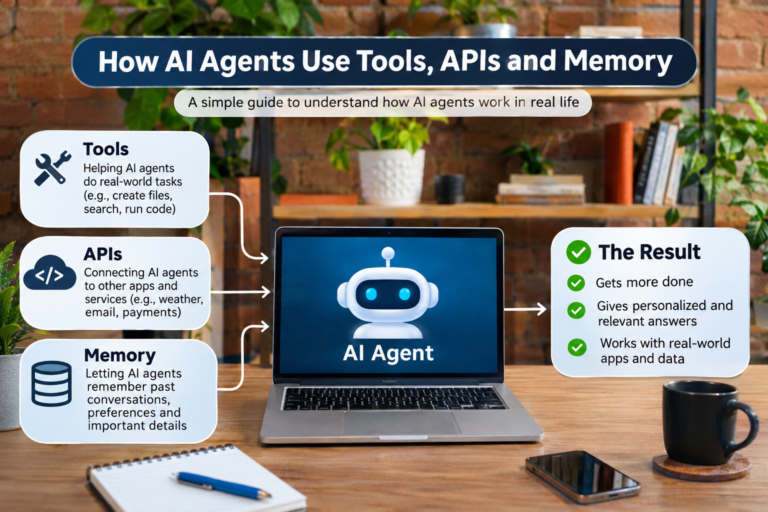
APIs and External Tools
Agents can use APIs to access external applications, databases, search services, and business software.
Memory and Context Management
Memory allows agents to retain relevant information during a workflow so that they can use previous results when completing later tasks.
Communication Protocols
Agents need ways to exchange messages, share results, and coordinate activities.
Workflow Orchestration
Orchestration manages task distribution, execution order, dependencies, and the overall progress of the system.
Together, these technologies allow multiple AI agents to operate as a coordinated system.
6. Popular Multi-Agent AI Frameworks
Developers can use different frameworks to build multi-agent applications without creating every component from scratch.
Some notable options include:
- LangGraph – Helps developers build stateful AI workflows with controlled execution, branching, and agent coordination.
- CrewAI – Provides an approach to organising AI agents into teams with defined roles and tasks.
- Microsoft AutoGen – Supports applications where AI agents and other participants communicate and collaborate.
- Semantic Kernel – Helps developers integrate AI models, plugins, and orchestration into applications.
Each framework offers different capabilities, so developers should select one according to their project requirements, technical experience, and infrastructure.
7. Benefits of Multi-Agent AI Systems
Why are organisations becoming interested in multi-agent architectures?
There are several reasons.
1. Division of Responsibilities
Complex activities can be divided into smaller tasks, allowing specialised agents to focus on individual responsibilities.
2. Better Workflow Organisation
A structured workflow makes it easier to manage activities, dependencies, and intermediate results.
3. Flexible Architecture
Developers can add, remove, or modify agents according to changing business requirements.
4. Parallel Task Execution
Independent activities can sometimes run simultaneously, reducing overall completion time.
5. Specialised Capabilities
Different agents can be configured with different tools, instructions, and access permissions.
6. Quality Checking
A dedicated review agent can evaluate the output of another agent and identify potential problems.
However, these benefits depend on good system design. Simply adding more agents does not automatically improve performance.
8. Challenges and Limitations of Multi-Agent AI
Despite its advantages, multi-agent AI also introduces some challenges.
Higher Development Costs: Running multiple agents can require more computing resources, model calls, and infrastructure.
Communication Problems: Agents may misunderstand instructions or pass incomplete information to one another.
Incorrect Information: If one agent produces inaccurate information, other agents may use it in their work.
Coordination Complexity: Managing multiple agents, their responsibilities, and their execution order can become difficult.
Security and Privacy: Agents with access to external tools or sensitive information need appropriate permissions and safeguards.
Unpredictable Results: Multiple agents interacting with each other can sometimes produce inconsistent or repetitive outputs.
For these reasons, successful multi-agent applications require careful planning, testing, monitoring, and human oversight.
9. What Is the Future of Multi-Agent AI?
The future of artificial intelligence may involve more collaborative systems rather than relying exclusively on individual AI models.
As AI capabilities continue to develop, multi-agent systems could become increasingly useful in areas such as business operations, software engineering, research, education, and customer experience.
Imagine a business where AI agents can monitor daily operations, analyse performance, identify potential problems, prepare reports, and recommend actions.
Or consider a software development environment where different agents help plan features, write code, test applications, and maintain documentation.
These possibilities are promising, but they also require reliable evaluation, human supervision, and responsible deployment.
The real opportunity is not simply to create more AI agents. It is to create systems where each agent contributes meaningful work towards a common objective.
Conclusion
Multi-Agent AI Systems represent an important development in the evolution of artificial intelligence.
By bringing multiple specialised agents together, these systems can divide complex activities, exchange information, use different tools, and coordinate their work towards a shared goal.
From business automation and software development to research and education, their potential applications are extensive.
However, their success depends on more than the number of agents involved. Clear responsibilities, reliable communication, accurate information, security, and proper coordination are essential.
As AI technology evolves, understanding how multiple agents work together will become an increasingly valuable skill for developers, businesses, and technology professionals.
The future of AI may not be about one intelligent system doing everything. It may be about multiple intelligent systems working together.
About the Author